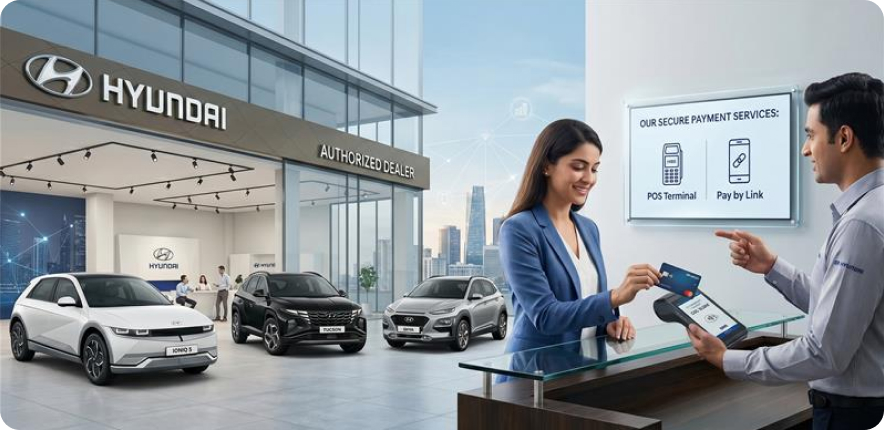
Why India's high-value vehicle payments are broken — and how KUN Hyundai fixed the experience
- CLIENT KUN United Car Trax Pvt Ltd (KUN Hyundai)
- INDUSTRY Automotive Retail
- SOLUTIONS PayByLink · Payment Gateway · POS Terminals
30s
To generate a PayByLink
T+1
Settlement — no bank windows
200+
Payment instruments accepted
Full
RBI PA Licence
The problem nobody talks about
Walk into any KUN Hyundai showroom and the experience is polished. The sales floor is curated, the staff is trained, the vehicles sell themselves. The moment a customer decides to buy — especially at the premium or international end of the range — something else takes over.
The payment process.
And in India, for high-value vehicle transactions, that process has not meaningfully evolved in years.
When a customer purchases an international or imported vehicle, the standard payment path defaults to RTGS or NEFT — interbank transfer protocols designed for large-value transactions. On paper, this seems appropriate. In practice, it creates a sequence of friction that neither the customer nor the dealership has a clean way around.
Under current banking regulations, transfers above ₹25,000 require the remitting party to add the receiving account as a registered beneficiary. That process takes time. It involves sharing full bank account details across whatever channel is convenient — often WhatsApp or email. And it is only the beginning.
RTGS transactions have defined operating windows and processing timelines. Customers frequently initiate transfers outside those windows. Banks fail to process them on the same day. Funds do not arrive. The car, meanwhile, sits.
This is not an edge case. It is a recurring operational reality for any dealership transacting at the premium end of the market. And the damage it creates goes beyond the inconvenience of a delayed handover.
A customer who has just committed to a significant purchase and is now waiting — for a bank window, for a beneficiary to be added, for a transfer to clear — is a customer whose post-sale experience is defined entirely by the limitations of payment infrastructure, not the quality of the vehicle or the dealership.
The dealership absorbs parking and holding costs. The customer absorbs frustration. The accounts team absorbs yet another exception case to manually track and resolve.
Scale built on trust, tested by infrastructure
KUN United Car Trax (KUN Hyundai) operates one of India's established Hyundai dealership networks — a multi-branch operation handling vehicle sales, service bookings, spare parts transactions, and insurance facilitation simultaneously, every day.
The sales floor experience had been refined over years. The payments infrastructure behind it had grown piecemeal: POS terminals from one provider, digital payments through another, no single view of what had cleared, what was pending, or what needed chasing. The accounts team carried the weight of that fragmentation.
At the premium end of the inventory — international and imported vehicles — the problem was compounded by the RTGS dependency. Each high-value transaction was a potential exception case. Each delayed transfer was a car that couldn't be released, a customer whose final impression of the brand was shaped by a bank's processing window.
— Nagendra Pathi, KUN United Car Trax Pvt Ltd
One link. Thirty seconds. Car released.
airpay's deployment at KUN Hyundai addressed the high-value payment problem directly — and resolved the broader fragmentation in the same move.
PayByLink — solving the high-value handover
For international and premium vehicle transactions, airpay’s PayByLink capability replaces the RTGS workflow entirely.
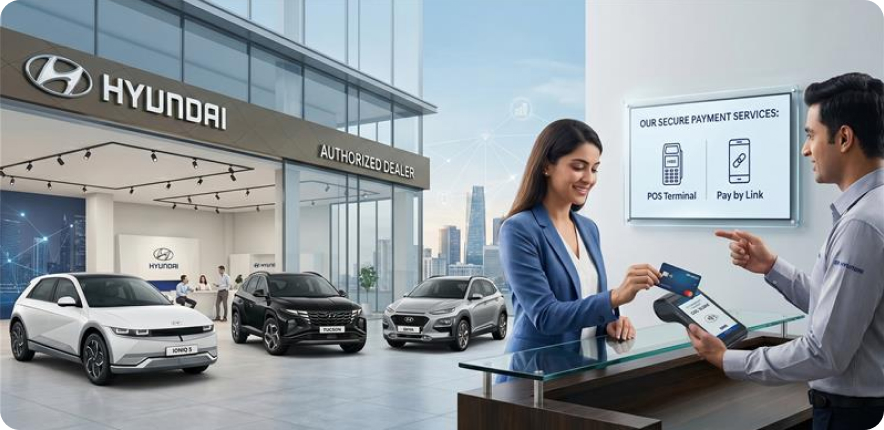
Instead of sharing bank account details and asking the customer to initiate a transfer with all the friction that entails, the dealership generates a secure payment link through airpay and sends it directly to the customer — over WhatsApp, SMS, or email. The customer pays through the link using their preferred instrument: UPI, cards, net banking. No beneficiary registration. No bank windows. No uncertainty about whether the transfer cleared.
Settlement hits the dealership on T+1. The car is released. No parking costs accumulate. The customer’s post-sale experience is defined by a payment that took seconds, not a transfer that took days.
The accounts team receives the payment against the correct invoice automatically. There is no exception case to track, no manual entry to make, and no follow-up call to the customer asking whether they managed to add the beneficiary details.
Payment Gateway + POS — closing the reconciliation gap
The PayByLink capability is built on a broader infrastructure layer that resolved KUN Hyundai’s day-to-day fragmentation simultaneously. The Payment Gateway now handles all digital acceptance across 200+ instruments — UPI, cards, net banking — on direct bank integrations with failover logic. POS terminals replaced existing hardware at each branch with a standardised setup, feeding into the same data layer as the Gateway
T+1 settlement across all instruments means the finance team has an accurate picture of previous-day collections every morning — automatically, without assembly. Reconciliation happens at the platform level. The accounts team stops being payment administrators and starts being financial analysts.
Why the gap is hard to close
The table below sets out where airpay’s infrastructure compares to typical alternatives. The PayByLink row is worth reading first: sending a customer a payment link is simple; having that payment auto-reconcile against the correct invoice, settle on T+1, and feed into the same reporting layer as every other transaction requires infrastructure depth that point solutions cannot provide.
| Capability | airpay | Typical Alternatives |
|---|---|---|
| High-value payment links | Instant PayByLink — no RTGS friction, no bank details shared | Manual RTGS / NEFT with beneficiary registration |
| Settlement speed | T+1 across all instruments, all channels | T+2 or T+3 common; RTGS subject to bank windows |
| RBI Licensing | Full PA licence — online, offline & cross-border | Limited or partial |
| POS + Gateway integration | Single platform, unified settlement and data | Separate vendors, manual consolidation |
| Multi-branch reporting | Consolidated, real-time | Requires manual aggregation |
| Instrument coverage | 200+ payment methods | Fewer direct integrations |
| Merchant support | Dedicated key account manager | Ticket queues, bot support |
What transformed at KUN Hyundai
— Nagendra Pathi, KUN United Car Trax Pvt Ltd
At the point of sale — premium and international vehicles
- High-value vehicle transactions no longer depend on RTGS windows or beneficiary registration workflows.
- Payment links are generated and dispatched in seconds; customers pay from any device through any preferred instrument.
- Vehicles are released on time. Parking and holding costs are eliminated. The post-sale experience matches the quality of the vehicle and the showroom.
- Every PayByLink transaction auto-reconciles against the correct invoice — no exception handling, no manual follow-up.
At the branch level
- Payment acceptance is consistent across all locations — same instruments, same reliability, same customer experience everywhere.
- Transaction success rates hold regardless of volume or promotional spikes.
- T+1 settlement means no morning spent chasing yesterday’s collections.
At the accounts team level
- Reconciliation across all branches happens automatically, without manual assembly.
- Transaction tracking accuracy has improved because POS data and Gateway data are the same data.
- One vendor relationship, one support contact, one platform — the coordination overhead of a fragmented stack is gone.
A pattern playing out across Indian business
KUN Hyundai is not a unique situation. Any business where transaction values are high and the moment of handover carries brand weight faces the same problem: a payment process that does not match the quality of what is being sold.
For premium automotive, the car sitting on the lot is the visible symptom. In enterprise software, it is a contract delayed by a wire transfer. In luxury retail, it is a customer whose final memory of the purchase is a bank error message. The category changes; the infrastructure failure is the same.
The businesses that resolve this fastest are the ones that have stopped treating high-value payments as a special case requiring a special workaround — and started treating them as a standard workflow that the payment infrastructure should handle cleanly, every time.
That is the practical case for airpay. Not as a payments provider that does more things, but as a platform that eliminates the friction between the things it does — including, and especially, at the moment a customer hands over a significant sum of money and waits to see what happens next.
— Nagendra Pathi, Accounts Department, KUN United Car Trax Pvt Ltd
airpay Full-stack financial infrastructure operating across India, UAE, and Tanzania. Acquiring, Lending, Distribution and Wealth Management. airpay.co.in