Seven out of every ten online purchases in India never make it past checkout. Merchants have spent a decade closing that gap one friction point at a time: saved cards, one-tap UPI, faster OTP delivery. Now a new kind of checkout participant has entered the picture: one that doesn't get distracted, doesn't lose the OTP, and doesn't abandon the cart.
Several of India's largest payment platforms have quietly started letting AI agents shop and pay on a customer's behalf, directly inside a chat window, with no app to switch to and no “Pay Now” button left for a human to tap. This isn't a future scenario. NPCI has already partnered with OpenAI to let customers shop and pay directly inside ChatGPT, and the rollout is confirmed to be expanding nationwide.
For merchants, the real question isn't whether agentic commerce is coming. It's what it means for your checkout, your compliance obligations, and your revenue. That's what this blog answers.
Table of Content
- What Are Agentic Payments? AI Agent Examples
- How AI Agents Are Changing Checkout in India
- Agentic Payments and UPI: India’s AI-ready payment rail
- Conversational Commerce vs. AI-Powered Checkout: What's Live now
- RBI Compliance for AI Payments: Building Trust and Human Oversight
- How Merchants Can Prepare for AI-Driven Payments
- Which Approach Fits Your Business? A Simple Decision Framework
- The future of AI in digital payments in India
- The Bottom Line
What Are Agentic Payments? AI Agent Examples
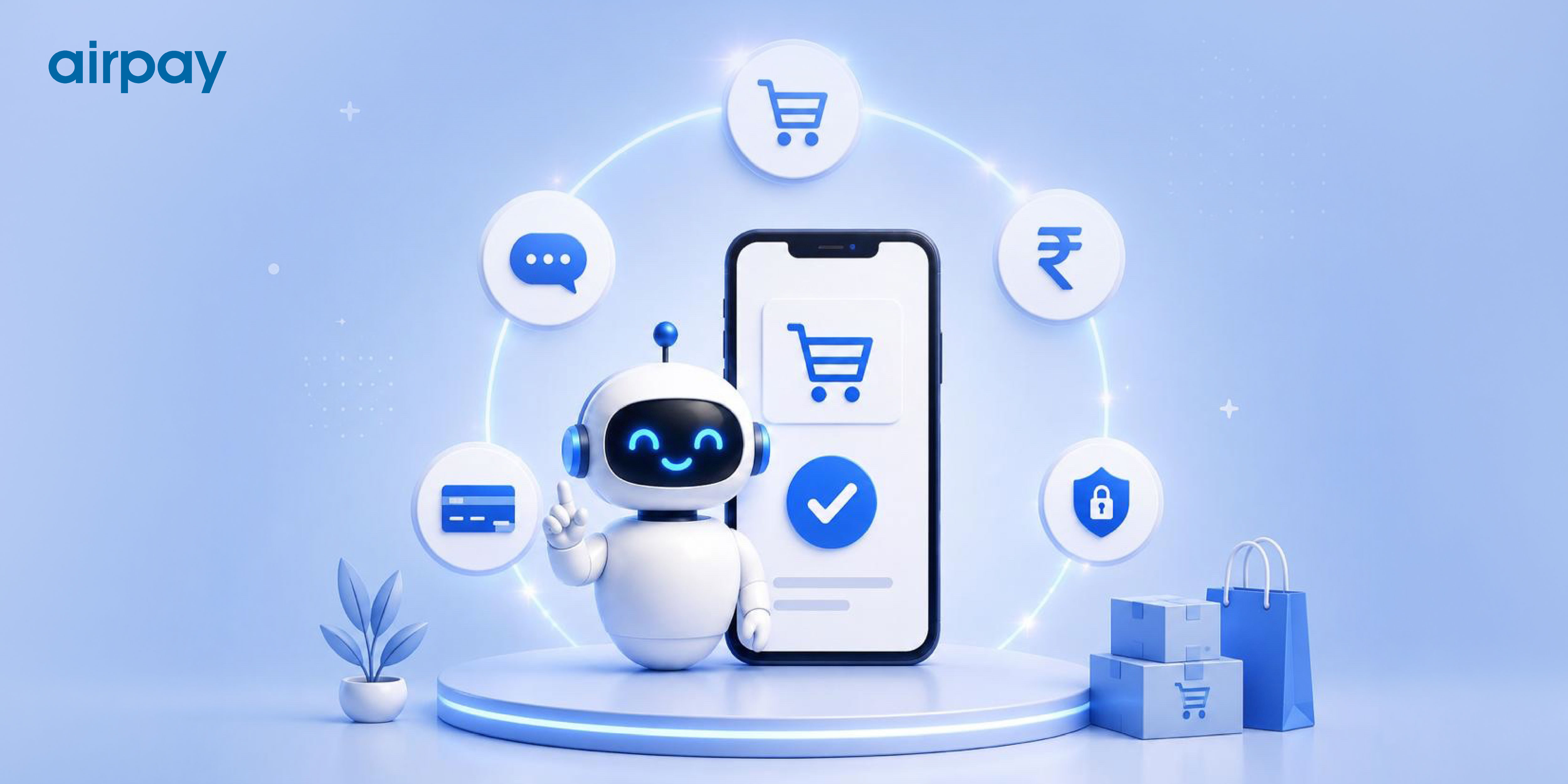
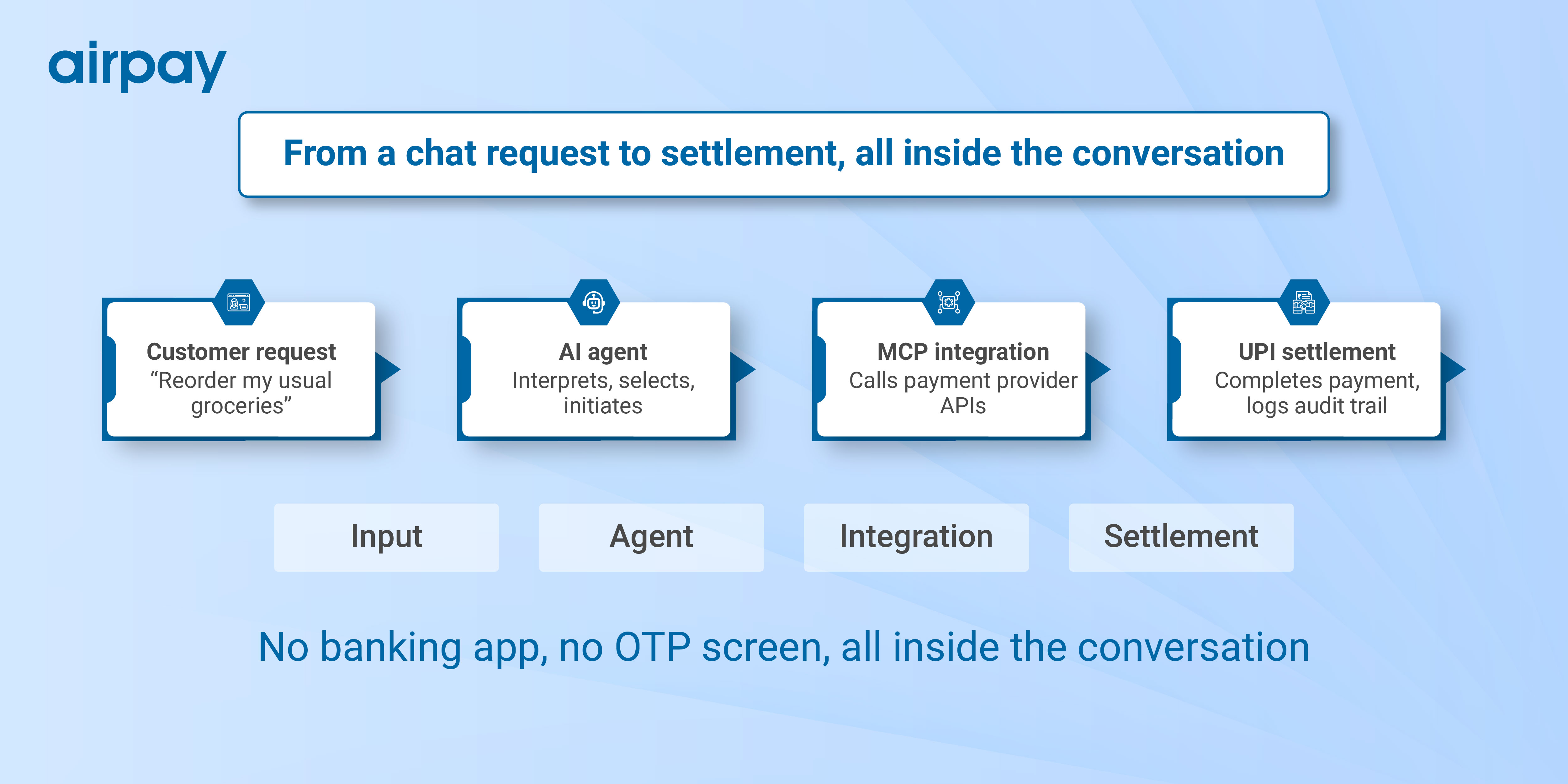
An agentic payment is a transaction an AI agent initiates and completes on a person's behalf, without requiring approval at every step. A customer might say, “Reorder my usual groceries,” and the agent takes it from there, interpreting the request, selecting the product, and completing payment using authority the customer granted in advance.
This is already live, not theoretical. Abandoned-cart agents reach out to customers who dropped off at checkout and send a new payment link. Dispute-response agents draft chargeback replies before a support rep even opens the ticket.
Most deployments today are “assisted” rather than fully autonomous: the agent handles discovery and drafting, but a person still approves the final payment. What's likely to change is how much standing authority agents hold: acting and paying within pre-set limits, without asking permission each time.
Read More: Why customers abandon checkout
How AI Agents Are Changing Checkout in India
For AI-powered checkout to become real, two things had to be true: AI needed a way to talk directly to payment systems, and those payment systems needed a way to trust an agent enough to move real money on someone's behalf.
The first problem is largely solved. The Model Context Protocol (MCP) is an open standard that lets an AI model call a payment provider's APIs directly, instead of a developer hard coding every possible request by hand. Arivu, airpay's AI layer for payments, is built on exactly this: connect the assistant you already use — Claude or ChatGPT and let it pull settlements, process refunds, verify orders, and handle everything else your business needs, without a developer writing custom integration code for each request.
The second problem is harder and is specific to India. NPCI, which runs UPI, is reportedly building a Unified Agent Protocol so AI agents can make UPI payments directly. In practice, that means a customer can simply tell an assistant “Order my usual groceries," and the agent handles the rest, completing the order and the UPI payment in the very same conversation. No banking app to open. No OTP screen to wait for.
Agentic Payments and UPI: India’s AI-ready payment rail
UPI already carries roughly 73% of online payments in Indian ecommerce, making it the obvious rail for agentic payments here in a way that is not true everywhere.
UPI trained Indian shoppers to pay without a card number or a redirect years ago. Merchants already running recurring UPI flows such as UPI AutoPay, covered in airpay's guide to UPI AutoPay vs. eNACH, are closer to agent-ready infrastructure than they might realise. Both rely on payment authority granted in advance, not approval requested in the moment — the same standing-authority logic already underpinning RBI's e-mandate rules for recurring payments.
Conversational Commerce vs. AI-Powered Checkout: What's Live now
Conversational commerce is shopping that never leaves the chat: discovery, comparison, and payment, all inside one thread. Some platforms have built this as a fully embedded experience, no redirects, no pop-ups. Others describe the same shift more simply, as commerce moving from clicks to conversations.
For a merchant sizing this up, what matters is not the pitch. It is what has actually shipped — and it extends a shift already underway, where online and offline checkout are converging across Indian retail. Four approaches are already live in the market:
| Model | does | Best fit for |
|---|---|---|
| Agent marketplace | Pre-built agents handle specific jobs, such as recovering an abandoned cart or drafting a dispute response, layered on top of in-chat UPI payments | Merchants who want ready-made automation without building agents themselves |
| In-chat, no redirect checkout | The full shopping journey, from discovery to payment, completes inside a single chat window with no redirects or pop-ups | Conversational commerce on WhatsApp, chat widgets or AI assistants |
| Developer-first integration | An MCP-style server that lets a merchant's own developers or AI tools call payment APIs directly, often paired with voice or regional language support | Merchants building custom or voice-first agent flows in-house |
| Protocol-first, UPI-native | A dedicated agentic payment protocol built directly on UPI for recurring or bill-style payments, with its own agent-authentication layer | Recurring billing, subscriptions, and bill payments handled by an agent |
None of these approaches spell out what happens when an agent-initiated payment goes wrong, who is on the hook, or what a business needs in place before flipping the switch. That part is worth solving before the exciting part.
If your checkout already runs on airpay, see how airpay supports every stage of the subscription journey before turning on any agent-facing payment flow, so authentication and refund handling are built in from day one, not bolted on after.
70% of online purchases in India fail to complete because of friction at checkout, particularly in chat-based environments where customers expect a purchase to finish instantly. (Industry estimate, Global Fintech Fest 2025)
RBI Compliance for AI Payments: Building Trust and Human Oversight
Trust in AI agents holding payment authority is not a hypothetical worry. It is exactly what regulators are moving on right now. CERT-In’s Digital Threat Report 2025-26 proposes mandating human-in-the-loop controls for agentic AI actions above a defined financial threshold, with a full audit trail attached. Separately, RBI has floated a draft framework that would require banks and NBFCs to build override, or “kill-switch,” mechanisms so a human can step in and shut down an AI model’s decision.
None of this is about shutting agentic payments down. It's about making sure a person can still intervene above a certain transaction size, and that every agent-initiated payment leaves a trail a regulator can inspect later. RBI's authentication Directions, effective from April 2026, already require a dynamic second factor for non-card-present transactions (the same compliance backbone already reshaping recurring billing), and it applies whether a person or an agent initiates the payment.
For a merchant, here's what that means in practice: trust in AI, when real money moves, is a compliance requirement, not a tagline. Any agentic payment flow you turn on needs to sit on infrastructure that already meets RBI's authentication rules and can produce an audit trail on demand. This is exactly where working with an RBI-licensed payment aggregator, rather than a workaround wired directly to an LLM provider, actually pays off.
How Merchants Can Prepare for AI-Driven Payments
What does this mean for one specific merchant, rather than the industry at large? A few moves are worth making now, ahead of the volume. Many of them mirror what we've already recommended for fixing broken B2B payment flows in India and for reducing mobile checkout drop-off, problems agentic flows will only amplify if left unresolved:
- Structure product and pricing data so a machine can read it cleanly. An agent needs data it can act on, not a page built for human eyes alone.
- Build MCP or an equivalent integration for order status, refunds, and disputes, so an agent-facing flow does not quietly create a second manual process behind it.
- Keep a human-approval path live above whatever threshold regulators eventually land on. Build for oversight, not just autonomy.
- Confirm the payment aggregator already meets RBI's authentication and audit-trail requirements before switching on any agent-initiated flow.
Which Approach Fits Your Business? A Simple Decision Framework
Running mostly card-led or one-off checkout? Start with the "assisted" model: let an agent handle discovery and drafting and keep a person approving final payment.
Already live on UPI AutoPay or e-mandate flows? You're closest to agent-ready; extending standing authority to an agent is a smaller lift than it looks.
Building a custom or voice-first agent in-house? You need an MCP-style integration, so your developers can call payment APIs the way an agent would.
Handling recurring billing or bill payments? A protocol-first, UPI-native agentic flow matters most here, since standing authority is already the norm.
The infrastructure decision that matters isn't which agentic model to pick first. It's whether your aggregator already meets RBI's authentication rules, so each new lane you open doesn't mean rebuilding the compliance layer from scratch.
The future of AI in digital payments in India
AI-driven payments won't replace the checkout Indian merchants have spent years refining. They'll run alongside it, carrying a growing share of transactions where the customer never opens an app at all. NPCI's Unified Agent Protocol and RBI's compliance framework are both still taking shape, which makes this year the year to get the plumbing ready, not the year to bet your whole checkout on it.
The Bottom Line
There's no single right way to adopt agentic payments, only the right sequencing for where your checkout stands today. Get the RBI-compliant authentication and audit-trail foundation right once, and every model after it becomes a smaller decision instead of a new project.
Ready to find out if your checkout is agent-ready? Talk to us, and we’ll check whether your authentication, refund, and audit-trail infrastructure already meets what agentic payments require.