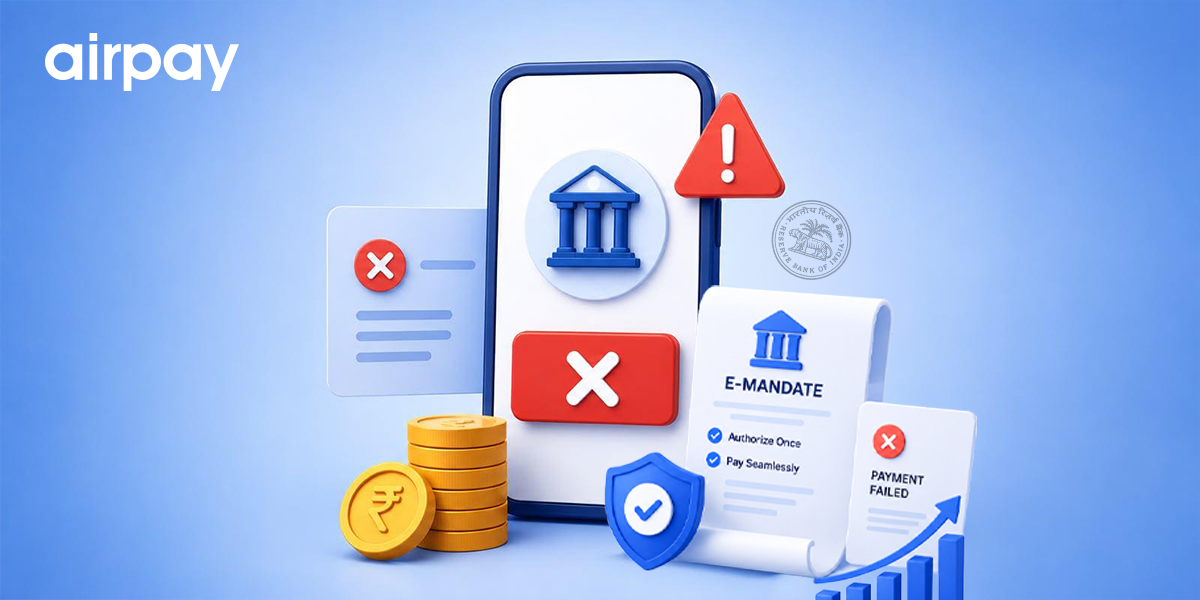
A failed recurring payment is never just one missed transaction. It's a customer locked out mid-cycle, a support ticket, and a renewal that quietly never happens. Multiply that across a billing book, and it becomes real revenue you never see leave.
If you collect recurring payments in India- whether you're a SaaS company billing subscriptions, an NBFC running lending and EMI collections, an insurer taking premiums, or a platform managing SIPs and memberships- most of that leakage traces back to one early decision: which recurring payment rail you built your collections on.
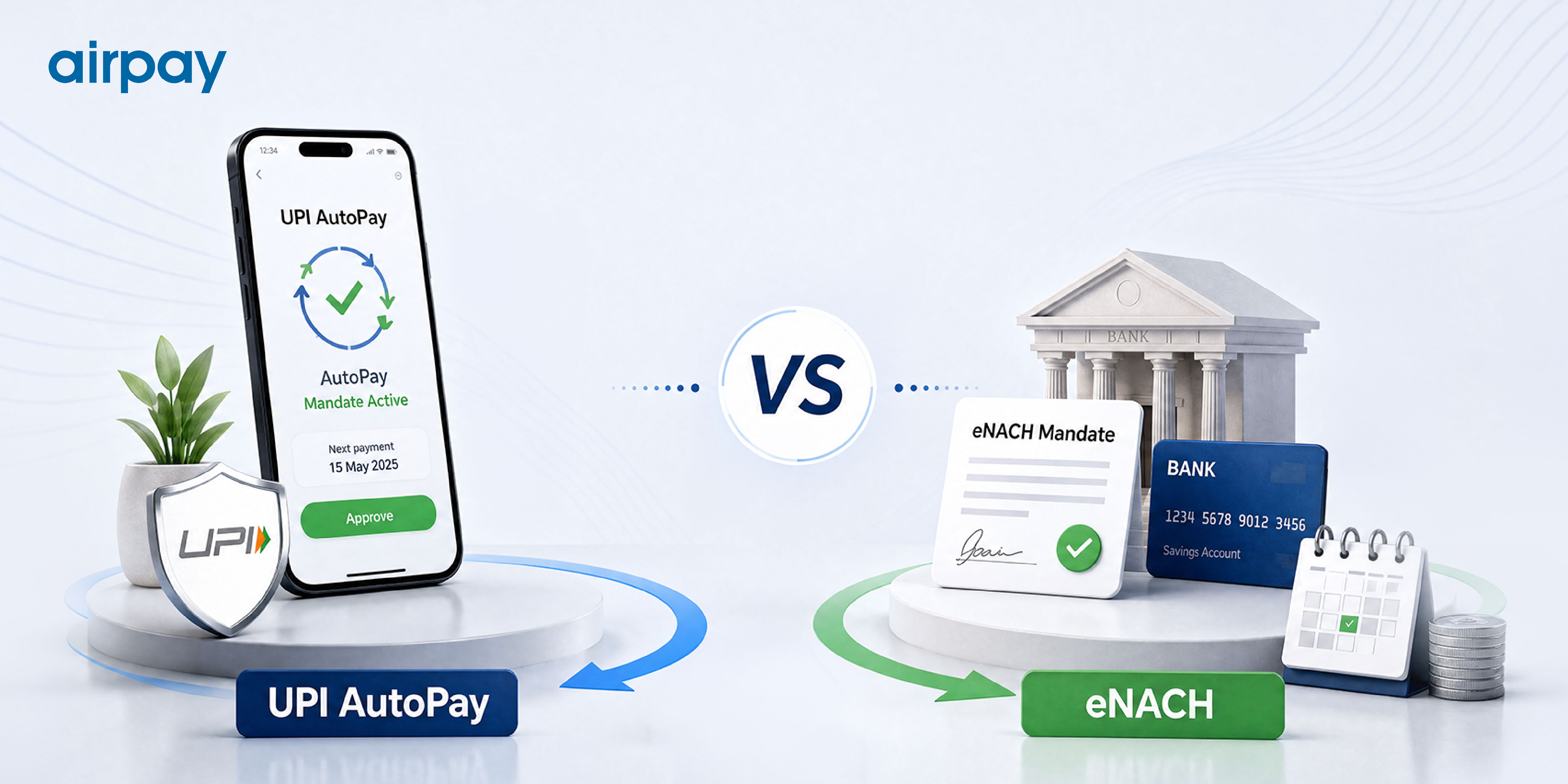
The two dominant options are UPI AutoPay and eNACH. Both are NPCI-backed, get authorised by a customer once, and are billed automatically. Neither is universally better. Each suits a different transaction profile, and picking the wrong one, or only one, costs you money every cycle.
This blog covers the numbers, but also what matters once you're live: retries, downtime, reconciliation, and how to choose the right recurring payment method for your business.
Key takeaways
- UPI AutoPay is the default for high-frequency, lower-ticket billing (typically under ₹15,000, up to ₹1 Lakh for select categories). It activates instantly and gives customers full self-service control.
- eNACH is the standard for high-value collections like loan EMIs and insurance premiums, and the default rail for NBFCs and lenders: higher limits and a stronger bank-verified audit trail.
- The costly mistake usually isn't the wrong rail. It's poor retry timing, unclear reconciliation, and no downtime fallback.
- Most mature billing stacks run both, routing each customer by ticket size and category.
Table of Contents
- Quick answer: UPI AutoPay vs eNACH
- What is UPI AutoPay?
- What is eNACH?
- How eNACH registration works?
- What actually decides which rail you should use?
- A worked example: same business, two rails
- What nobody tells you: the operational playbook
- When to use UPI AutoPay?
- When to use eNACH?
- How airpay helps you run both?
- The bottom line
- Frequently Asked Questions (FAQs)
Quick answer: UPI AutoPay vs eNACH
| Parameter | UPI AutoPay | eNACH |
|---|---|---|
| Best for | Low-to-mid ticket, high-frequency billing (SaaS, OTT, memberships) | High-value, high-certainty billing (NBFC EMIs, premiums) |
| Typical limit | ₹15,000 per debit without extra authentication; up to ₹1 Lakh for specific categories (SIPs, insurance, credit card bills) | Up to ₹1 Crore for e-mandates; higher via paper-based NACH depending on bank policy |
| Setup time | Under a minute, approved via UPI PIN in-app | A few minutes to authorise, but the eNACH mandate activates over T+1 to T+7 days |
| Authentication | UPI PIN, inside the customer's UPI app | Net banking, debit card + OTP, or Aadhaar-based e-sign |
| Debit processing | Real-time, dependent on UPI app/bank uptime at execution | Batch-based via NPCI's clearing house, steadier once active |
| Cancellation | Customer can pause/cancel instantly from any UPI app | Usually needs net banking, a branch visit, or a merchant request |
| Cost profile | Lower MDR, generally no failure penalty to the customer | Per-transaction fee; failed debits (“bounces”) can trigger bank charges of ₹200 to ₹750 |
| Typical use cases | OTT, SaaS, utility bills, donations, micro-SIPs | Loan EMIs, high-value insurance, education fees, B2B retainers, institutional collections |
Note: Limits and fees are set by NPCI/RBI and individual banks and are periodically revised. Always confirm current thresholds with your payment partner before going live.
What is UPI AutoPay?
UPI AutoPay is NPCI's recurring-payments layer built on top of UPI. A UPI mandate is a standing instruction that a customer approves once in their UPI app, authorising a business to debit future payments automatically within set limits. Instead of approving each payment, the customer approves once, and subsequent debits are processed automatically.
It's built for speed: no redirect, no form-filling, no bank portal. The customer sees a UPI AutoPay mandate request in their UPI app (Google Pay, PhonePe, Paytm), reviews the amount cap and frequency, and confirms with their UPI PIN.
What makes it distinctive for businesses:
- Instant activation. Live the moment the PIN is entered.
- Variable billing. Bill different amounts each cycle up to the cap, which suits usage-based pricing.
- Frequency flexibility. Daily, weekly, monthly, quarterly, yearly, or “as and when presented.”
- Full customer control. Customers view, pause, or cancel from their UPI app, with no merchant intervention.
In December 2023, under RBI's e-mandate guidelines, the RBI raised the no-additional-authentication limit for e-mandates (including UPI AutoPay) from ₹15,000 to ₹1 Lakh for mutual fund subscriptions, insurance premiums, and credit card bills.
(Source: RBI monetary policy, December 2023, via Business Standard)
What is eNACH?
eNACH, short for Electronic National Automated Clearing House, is the digital successor to India's paper-based NACH system. The eNACH meaning is straightforward: the same bank-to-bank recurring debit process, moved online, with digital authentication replacing physical signatures.
Where UPI AutoPay runs through a UPI app, eNACH runs through the customer's bank. A customer authorises an eNACH mandate via net banking, debit card + OTP, or Aadhaar-based e-sign, and the business's sponsor bank submits the debit to the customer's bank via NPCI.
What makes it distinctive for businesses:
- Built for scale and value. Much higher limits than UPI AutoPay, the standard for EMIs, high-value premiums, and institutional collections.
- Batch-based stability. Once active, debits run through core banking rails, steady and predictable for bulk processing.
- Stronger paper trail. Bank-verified authentication gives a defensible audit trail for regulated credit-linked collections.
In 2023, NPCI harmonised electronic mandate limits with physical NACH, raising the e-mandate ceiling to ₹1 Crore. That's a big reason eNACH remains the default for large-ticket, long-tenure commitments like loan EMIs.
(Source: NPCI e-mandate harmonisation circular, July 2023, via TeamLease RegTech.)
How eNACH registration works
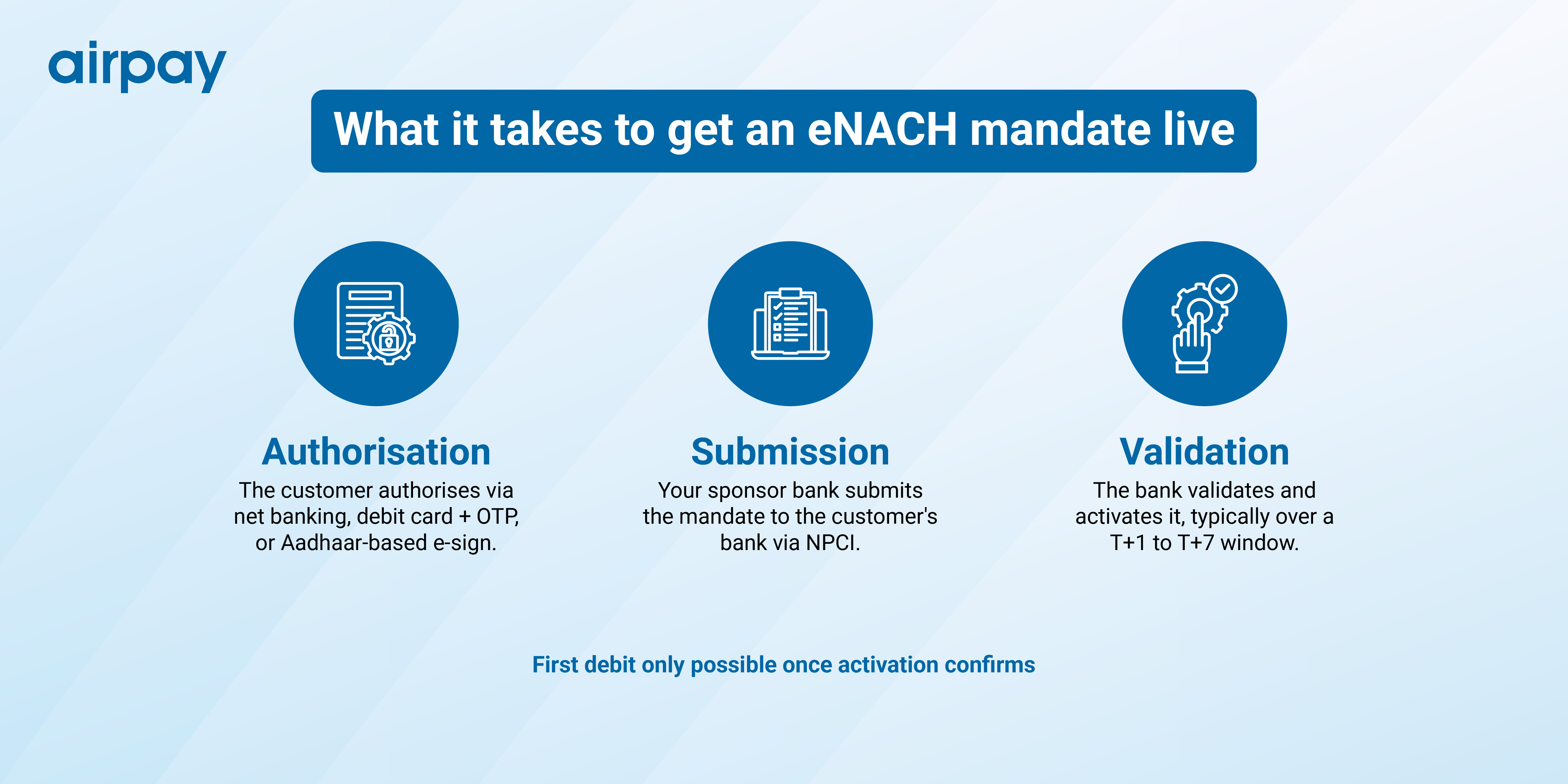
The eNACH registration process is the setup step before any debit can occur, and it shapes your first collection timeline. It runs in three parts:
- Authorisation. The customer authorises via net banking, debit card + OTP, or Aadhaar-based e-sign.
- Submission. Your sponsor bank submits the mandate to the customer's bank via NPCI.
- Validation and activation. The bank validates and activates it, typically over a T+1 to T+7 window.
Unlike UPI AutoPay, an eNACH mandate can't be debited the moment it's created. The first collection waits until the bank confirms it's live, which is why eNACH registration timing matters for anything time-sensitive, like a day-one subscription or a first EMI.
What actually decides which rail you should use
Forget the generic “UPI AutoPay is faster, eNACH is bigger” line. Here's what drives the decision in practice.
1. Your average ticket size. The single biggest factor. Under ₹15,000, UPI AutoPay's frictionless flow converts better. Collecting tens of thousands to lakhs on EMIs, premiums, or tuition, you're outside its range and need eNACH.
2. How fast you need the first collection. UPI AutoPay activates in real time, so you can bill a new subscriber on day one. eNACH's multi-day validation leaves a window, sometimes up to a week, where no collection can happen, which loses trial-to-paid conversions.
3. How much certainty you need. Once active, eNACH's batch clearing is very stable, which is why it's the default for EMIs, where a missed collection has real consequences for an NBFC or lender. UPI AutoPay converts well but depends on app and bank uptime at the moment of debit.
4. How much control customers expect. UPI AutoPay lets customers cancel from any app instantly, which lifts subscription sign-ups. For NBFCs and lenders managing EMIs, that same easy cancellation is a risk, which is why sticky high-value billing leans on eNACH.
5. What a failed payment costs you. UPI AutoPay failures are low friction: you retry, with no bank penalty. eNACH bounces can trigger bank charges of ₹200 to ₹750, which can damage goodwill on low-value plans. That's why eNACH economics work for a ₹25,000 EMI but get awkward for a ₹299 OTT plan.
(Range per industry sources including The Zavo; charges vary by bank.)
A worked example: same business, two rails
Say you run a SaaS business with 10,000 customers on a ₹499/month plan.
On eNACH, every mandate goes through bank authentication and a multi-day activation window, each debit carries a processing fee, and every failure can trigger a bounce charge. That fixed per-debit cost eats into a ₹499 plan far more than into a ₹25,000 EMI, where the same fee is a rounding error.
On UPI AutoPay, mandates activate in under a minute, debit costs are lower, and failures carry no bank penalty, so retries are cheap. The trade-off is reliability at the moment of debit: independent analysis puts UPI AutoPay's real-time failure rate at 8% to 15%, above card-based mandates at roughly 2% to 3%. The same analysis found the fix: spacing retries across a 24-hour, 72-hour, and 7-day window, plus a short grace period, recovered around 15% to 20% of otherwise-failed payments.
On eNACH mandate success rate vs UPI AutoPay: UPI AutoPay has fewer drop-offs at mandate creation; eNACH is steadier on ongoing debits once active. For a low-ticket, high-volume book, UPI AutoPay is the natural primary rail, with eNACH or a card mandate as fallback for any tier crossing ₹15,000.
What nobody tells you: the operational playbook
This is where businesses actually lose money.
Retries are strategy, not a formality. Since NPCI's August 2025 UPI update, the retry sequence runs on a hard limit: one original attempt plus up to three retries — four per cycle — after which the cycle is cancelled, and debits are confined to non-peak windows. Within that cap, space attempts across a 24-hour, 72-hour, and 7-day window with a short grace period — not back-to-back.
(Source: NPCI UPI framework update effective 1 August 2025, via IBS Intelligence.)
Reconciliation differs by rail. UPI AutoPay settles in near real-time; eNACH's batch settlement surfaces outcomes, including bounces and bank charges, with a delay. Your reporting should separate mandate status (active/pending/cancelled) from debit status (success/failed/bounced).
Plan for downtime. No real-time rail has zero downtime. A well-built stack queues a retry or routes to an alternate method rather than silently failing, which is where running both rails pays for itself.
Match dunning to the rail. A UPI AutoPay failure and an eNACH bounce mean different things: one a low balance, the other a bank penalty. Your win-back messaging should reflect that, not fire the same generic “payment failed” email.
When to use UPI AutoPay
- Subscription products. OTT, SaaS companies and software-as-a-service startups, edtech, fitness, and memberships under ₹15,000.
- Utility and recurring bills. Predictable, moderate amounts.
- Micro and starter SIPs. Small investors who want fast in-app setup.
- Donations and recurring contributions. Where easy setup drives participation.
- Usage-based or metered billing. Variable amounts that don't fit a fixed mandate.
When to use eNACH
- Loan EMIs. NBFCs, banks, and other lenders collecting home, personal, and vehicle loan repayments above UPI AutoPay's range.
- High-value insurance premiums. Annual or quarterly, running into lakhs.
- Education fees. Semester or annual tuition, large and time-critical.
- B2B retainers and vendor payments. Current accounts with multi-signatory needs that UPI AutoPay doesn't support.
- Institutional or bulk collections. Where batch reliability beats setup speed.
Most mature businesses don't pick one. They run UPI AutoPay for low-ticket, high-frequency collections and keep eNACH (or cards) for the higher-value tail, routing by size and eligibility.
How airpay helps you run both
Choosing a rail is a five-minute decision. Running two rails well, day after day, is the actual work. airpay's recurring payments infrastructure takes that load off your team:
- Unified payment mandate management across UPI AutoPay and eNACH, one integration and one view.
- Configurable retry logic you can set per product within NPCI's limits.
- Rail-aware reconciliation that separates mandate status from debit status.
- Automatic fallback routing when a preferred rail hits a downtime window.
- Built-in security and compliance safeguards, with mandate-level audit trails and NPCI- and RBI-aligned processing.
- One dashboard for active mandates, debit schedules, and failure trends.
If you're building or re-architecting your billing stack, map your ticket sizes and failure costs against this framework before you commit. We're happy to walk through what that looks like for your model.
The bottom line
UPI AutoPay and eNACH aren't rivals. They're two tools for different jobs. UPI AutoPay wins on speed, conversion, and customer control for everyday, lower-ticket billing. eNACH wins on scale, certainty, and audit trail for high-value collections.
The businesses that get the most out of recurring payments in India don't pick a side. They route intelligently between both, and treat the operational details — retries, reconciliation, downtime — as seriously as the rail choice. Get that right, and recurring payments stop being quiet revenue leakage and become what they're meant to be: predictable, automated, and mostly invisible.
Running two rails shouldn't mean running two systems. See how airpay brings UPI AutoPay and eNACH under one dashboard
Frequently asked questions
What does eNACH mean?
eNACH stands for Electronic National Automated Clearing House, the online version of India's paper-based NACH mandate system. It lets a business collect recurring bank-to-bank debits after a customer authorises a mandate digitally.
What is a UPI mandate?
A standing instruction a customer approves once in their UPI app, authorising a business to debit future payments automatically within a set amount cap and frequency. UPI AutoPay runs these mandates.
How does eNACH registration work?
The customer authorises via net banking, debit card + OTP, or Aadhaar-based e-sign. The sponsor bank submits it through NPCI to the customer's bank, which validates and activates it over a T+1 to T+7 window before the first debit can run.
How do I set up UPI AutoPay for my business?
Integrate UPI AutoPay through a payment partner, then present customers a mandate request in their UPI app with the amount cap and frequency. Once they approve with their UPI PIN, the mandate is live instantly.
What's the best recurring payment method for a small business in India?
It depends on ticket size. For low-value, high-frequency plans under ₹15,000, UPI AutoPay usually converts best. For high-value or credit-linked collections like EMIs, eNACH is the stronger fit. Many run both and route by amount.
Which one has a better success rate?
It depends on what you measure. UPI AutoPay has fewer drop-offs at mandate creation; eNACH is steadier for ongoing debits once active. The right question is which succeeds more for your ticket size and customer base.