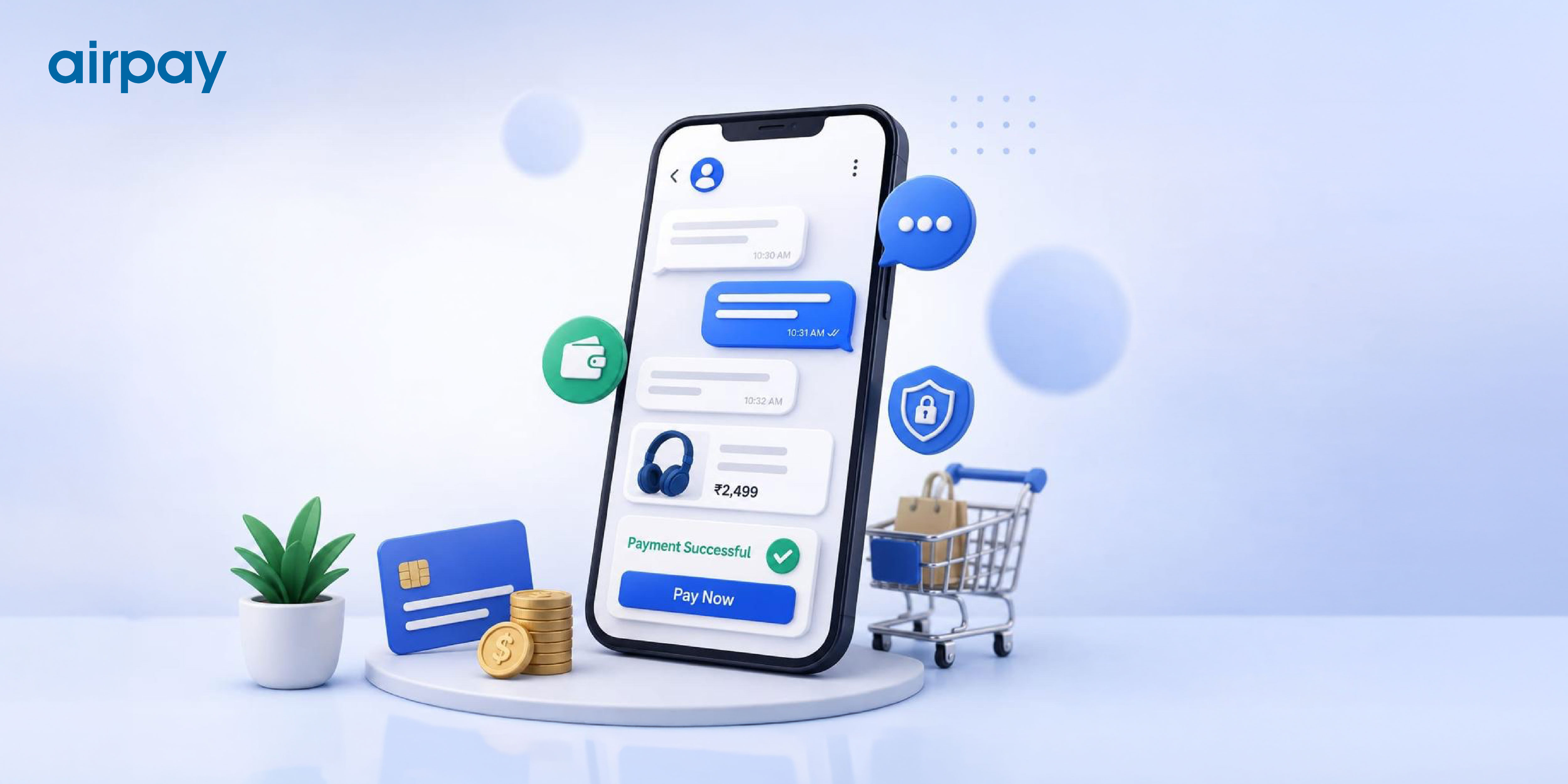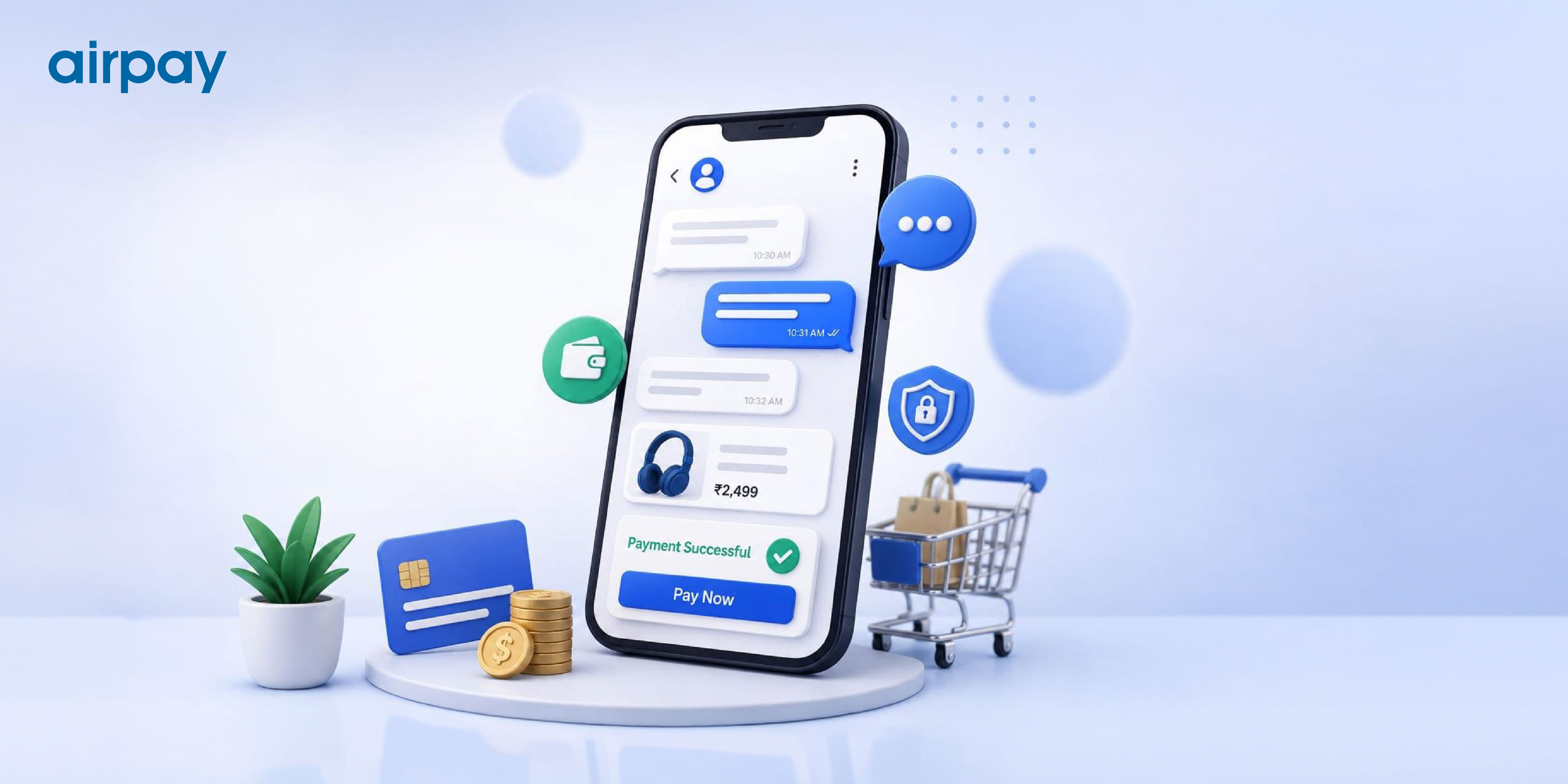
Ask an AI chatbot to find you a saree for a wedding, and it will happily oblige. Ask it actually to buy that saree, and the conversation breaks. A link opens. A new tab loads. And the shopper who just trusted an AI to guide the entire decision is suddenly on their own to finish the transaction, the same checkout drop-off that's long plagued mobile commerce, now playing out inside a chat window instead of a browser.
That handoff, small as it looks, is the single biggest gap in what gets marketed as "AI commerce" in India today. The idea behind conversational commerce is simple: if a customer can discover a product, ask questions about it, and decide to buy it, all inside a chat, why should paying for it require leaving the conversation? Over the past year, that question has moved from theory to pilot, backed by NPCI, several large payment aggregators, and a fast-growing base of shoppers who already trust AI chat tools with their buying decisions.
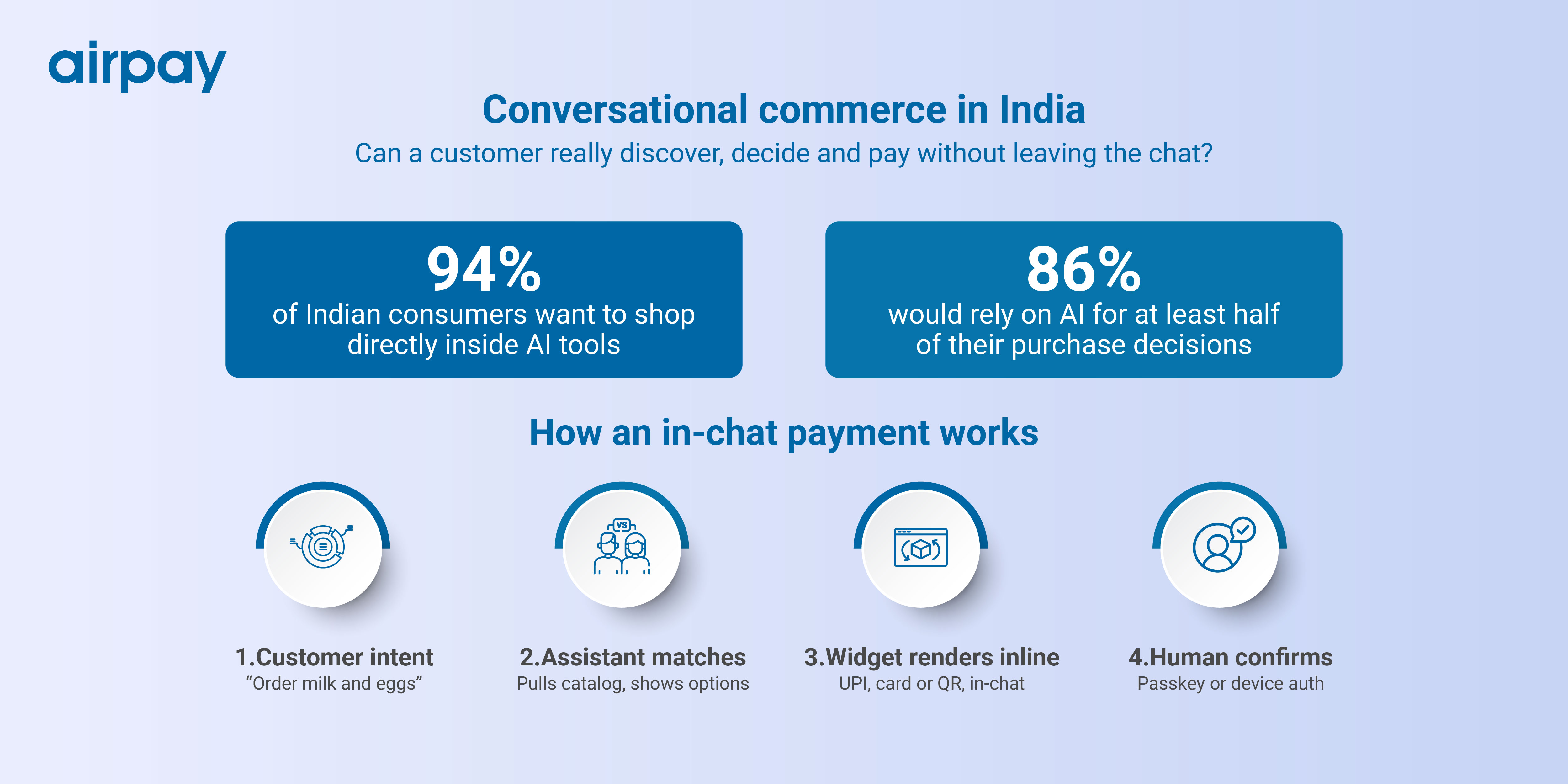
The scale of that trust is hard to ignore. 94% of Indian consumers say they'd like to shop directly inside generative AI tools, and 86% say they're likely to rely on these tools for at least half of their purchase decisions (Accenture's Consumer Pulse Survey 2026). That's an enormous amount of buying intent sitting inside a chat window, with nowhere to spend it unless the payment layer catches up.
This blog breaks down what conversational commerce actually means for a merchant: how in-chat payments work, where voice assistants fit, what NPCI's proposed rules mean for your business, and what to check before you plug your payment stack into a chat interface.
Key Takeaways
- True conversational commerce means the entire purchase, including payment, happens inside the chat. If the customer gets redirected to a checkout page, that's conversational marketing, not conversational commerce.
- Three things make in-chat payments possible in India: a standard way to embed a checkout widget inside a third-party AI app, UPI as the real-time settlement rail, and regulatory comfort with AI-initiated transactions.
- The mechanics build on existing infrastructure. A merchant extends their current PA-compliant payment integration through a standard like MCP rather than building a new checkout from scratch.
- NPCI's Unified Agent Protocol (UAP) is still a proposal under industry consultation, not a live standard, and needs RBI approval before AI agents can initiate UPI payments at scale.
- Every in-chat payment today still requires a human to confirm the transaction. Fully autonomous, agent-initiated checkout without human confirmation isn't yet permitted in India.
- Early regulatory use cases under discussion are deliberately low-stakes: groceries, subscriptions, and other small, repetitive purchases, not high-value or one-off transactions.
- Before setting up chat payments, a merchant needs structured, machine-readable product data and an existing UPI- and card-ready payment gateway. Without those two, a chat payment pilot means rebuilding the payment stack, not extending it.
Table of Contents
- What Conversational Commerce Means
- How Do In-Chat Payments Actually Work?
- Where Do Voice Assistants Fit In?
- AI Payments Regulation in India: NPCI's Unified Agent Protocol
- Conversational Commerce vs Social Media Commerce vs SMS Commerce
- Should Your Business Set Up Chat Payments Now? A Readiness Checklist
- Get Your Payment Stack Chat-Ready
What Conversational Commerce Means
The term "conversational commerce" doesn’t have one fixed meaning. Sometimes it means an AI chatbot answering product questions on a website. Sometimes it means a customer service bot on WhatsApp. For this blog, conversational commerce means something more specific: a shopper completes the entire purchase journey (discovery, comparison, decision, and payment) without leaving a single chat interface.
That last part matters most. An AI chatbot that recommends a product but then sends the customer to a separate checkout page isn't conversational commerce in the full sense; it’s conversational marketing with a redirect attached. True chat payment is when the payment widget renders itself inside the conversation, whether that conversation runs on a large language model app, a WhatsApp Business number, or a voice assistant.
Three things had to come together to make this possible in India:
- A standard way for a payment provider to place an interactive checkout widget inside a third-party AI app.
- A trusted, real-time settlement rail, which almost always means UPI, the same rail airpay's Unified Payments engine is built to route through.
- Regulatory comfort with AI systems initiating and completing financial transactions on a person's behalf.
How do in-chat payments work?
The mechanics are less complicated than the marketing around them suggests. Most in-chat payment setups today follow the same rough sequence:
- The customer expresses intent inside a chat app, for example, "order milk and eggs" or "book a table for two tonight."
- The AI assistant matches a product or service, usually pulling from a merchant's structured catalog data, and shows options inside the conversation.
- Once the customer picks an option, the payment provider renders a live payment widget inline, using UPI, a saved card, or a QR code, instead of opening a new browser tab.
- The transaction completes with device-level or passkey-based authentication, and the merchant receives a standard confirmation, exactly as if the sale had happened through a normal checkout page.
Several large Indian payment aggregators have built pilots and live extensions on this model over the past year, connecting their payment stack to major AI chat platforms through the Model Context Protocol (MCP). This open standard lets AI applications call external tools, including payment tools, in a structured way. Card and UPI details stay with the payment provider and never pass through the AI model itself. The compliance boundary stays in a familiar place even though the interface is new.
For a merchant, the practical shift is smaller than it sounds. You aren't building a new checkout from scratch. You're extending an existing airpay payment gateway integration, so it also responds inside a chat interface, provided your payment partner has already connected to that interface.
Where do voice assistants fit in?
Voice is the quieter half of conversational commerce, and it is moving fast in specific corners. Voice-based UPI authorisation is already live for use cases such as EMI collections, where a customer confirms and settles a repayment during a live call rather than receiving a separate payment link afterward. Marketing and lead-generation bots are starting to trigger real-time payment links mid-conversation once a customer signals buying intent on a call.
For merchants, voice assistants matter most right now in two places. The first is collections: turning a reminder call into an actual payment. The second is low-friction reorders, where a returning customer settles a bill by voice instead of opening an app. Full voice-led product discovery and checkout, the kind where a customer asks a smart speaker to browse and buy, is still early in India and worth watching rather than building around today.
AI Payments Regulation in India: NPCI's Unified Agent Protocol
This is the part most coverage of conversational commerce skips, and it's the part that should shape your rollout timeline.
NPCI is developing a Unified Agent Protocol (UAP), a framework meant to let AI agents register, get verified, and get authorised to initiate UPI transactions on a person's behalf, without changing UPI's existing rails. The protocol builds on the delegated-payments model already used in UPI Circle, and it's expected to include spending limits, user consent controls, and audit trails, so a disputed AI-initiated payment can be traced the same way a normal UPI transaction can.
As of mid-2026, the UAP is still a proposal under industry consultation, not a live standard, and any rollout will need the RBI's approval before AI agents can initiate UPI payments at scale. Early use cases under discussion are deliberately low-stakes: groceries, dairy subscriptions, and other small, repetitive purchases, rather than high-value or one-off transactions. UPI itself is not a small testing ground either; it processed 22.71 billion transactions worth ₹28.92 trillion in June 2026 alone, so any change to how consent and authorisation work on that rail gets scrutinised carefully before it ships.
The practical takeaway for a merchant: today's in-chat payment flows still rely on a human tapping to confirm, the same consent step as a normal UPI payment, just rendered inside a chat window. Fully autonomous, agent-initiated payments without human confirmation aren't yet permitted in India and won't be until the UAP has RBI sign-off. Treat any claim of "fully autonomous AI checkout" in India today with some skepticism, and build your rollout around the current, human-confirmed model rather than the future one.
airpay operates as an RBI-authorised payment aggregator (PA-O, PA-P, PA-CB) across India, UAE, and Tanzania, which matters here specifically because a conversational commerce integration inherits its compliance posture from the underlying payment aggregator, not from the chat platform it sits inside.
This also overlaps with recurring-payment approaches merchants already use for subscriptions, like the consent and mandate structure covered in UPI AutoPay vs eNACH, and the broader authentication changes discussed in RBI's E-Mandate Rules and Recurring Payment Failures.
Conversational Commerce vs Social Media Commerce vs SMS Commerce
These terms overlap enough to confuse a marketing brief. Conversational commerce is sometimes called chat commerce, and it sits close enough to social media commerce and SMS commerce. Here is a quick comparison.
| Channel | What it is | Where payment happens | Best for |
|---|---|---|---|
| Conversational commerce (AI chat apps) | Discovery, comparison, and decision-making inside an AI chat app such as ChatGPT or Claude | Inline payment widget rendered inside the same chat | High-intent shoppers already using AI for research |
| Social media commerce | Product discovery inside social app's native shop tab | Native in-app checkout, or a redirect to the brand's own site | Impulse and discovery-led buying |
| SMS and Whatsapp commerce | Ordering and support conducted through text messages | A payment link sent as a message, or an inline widget on newer setups | Repeat customers, reorders, lower-bandwidth users |
| Voice commerce | Ordering or confirming a purchase through spoken conversation with a voice assistant | Voice-authorised UPI or card transaction, mostly for collections today | Bill payments, EMI collections, subscription confirmations |
Should Your Business Set Up Chat Payments Now? A Readiness Checklist
Most merchants don't need to build a chat payment integration this quarter. A smaller number should start now. Ask these questions before deciding:
- Does a meaningful share of your customers already discover you through AI chat tools or WhatsApp, rather than a website search?
- Are your products described in structured, machine-readable data (name, price, availability, specs), or only in images and PDFs a chat assistant can't easily parse?
- Do you already have a PA-compliant payment gateway integration that supports UPI and cards, or would a chat payment pilot mean rebuilding your payment stack from scratch?
- Can your customer support and dispute process handle a transaction that originated inside a third-party AI chat rather than your own website or app?
- Are your highest-volume products or services low-value and repetitive, like subscriptions or reorders, matching the use cases regulators are prioritising first?
If most of those answers are no, spend this quarter cleaning up product data and confirming your payment gateway is chat-ready, rather than racing to launch inside a specific AI app. The airpay MCP Server extends an existing payment integration to AI chat interfaces without a separate technical build, which is the practical starting point for most merchants weighing this decision.
Get Your Payment Stack Chat-Ready
Conversational commerce in India is past the pilot stage for a handful of large platforms, and still ahead of most merchants. The businesses that see the earliest gains will be the ones whose payment stack was already built to extend into a chat interface when the moment came, not the ones retrofitting one after the fact.
If you already run a PA-compliant gateway with airpay, extending it into chat is a configuration step, not a rebuild. Talk to us about connecting your existing payment integration to the MCP Server, and get a head start before conversational commerce stops being a pilot and becomes table stakes.