A payment failure during the festive season is never just one lost sale. It's a customer who doesn't come back, a support ticket that lands in your busiest week, and a return that surfaces three weeks later as a Return to Origin (RTO). Multiply that across your festive traffic, and it adds up to revenue you spent months earning and never actually collected.
Navratri, Dussehra, and Diwali fall within weeks of each other every year, adding up to roughly a month during which Indian shoppers do a disproportionate share of their annual spending. Navratri-to-Diwali retail trade regularly crosses ₹5+ lakh crore, with online festive GMV growing over 20% year on year.
Your festive sale creative is ready. Inventory is stocked. Then, ten minutes into a flash sale, your checkout success rate drops and orders start vanishing before the payment confirmation loads. Nobody files a complaint; they just leave. That is the part of the festive season most merchants do not plan for. Discounts and campaigns get months of attention. The payment gateway that all that traffic gets tested on for the first time is on the sale day itself.
During festive peaks, Diwali week can push order volumes up to 3x a normal day, and around 20% of cart abandonments during peak periods trace back to gateway errors and slow checkout pages, not price.
This is a working checklist: what an ecommerce merchant actually needs to check, fix, and test before the festive rush hits, from checkout speed to settlement timing to platform integrations.
Key takeaways
- Payment readiness must start at least 6 to 8 weeks before your first festive sale, not the week before.
- A fast, easy checkout and full payment method coverage are the deciding factors for how much traffic actually converts. A narrow or slow checkout quietly loses revenue.
- RTO is mostly a checkout problem wearing a logistics label: bad addresses, no prepaid nudge, no risk screening.
- Fraud patterns shift during the festive season: new customers, bigger baskets, unfamiliar devices. Risk rules need a festive-specific review, not your default settings.
- Most merchants don't require a new payment gateway for the festive season. They need to confirm the one they have is carefully configured.
Table of Contents
- Why the festive season is a payment problem before it's a marketing one
- Why your payment gateway decides the festive season, not your discounts
- The festive season ecommerce checklist
- What actually breaks first
- Fast, one-click checkout: where merchants lose sales without noticing
- Payment methods merchants should offer this festive season
- High-traffic readiness: handling peak loads without losing transactions
- Instant settlements: why cash flow breaks during the Diwali weekend
- Ecommerce integrations: is your platform actually festive-ready?
- Choosing the best payment gateway for high-volume festive sales in India
- How airpay gets you festive-ready
- Frequently Asked Questions (FAQs)
Why the festive season is a payment problem before it's a marketing one
Most festive planning happens in a familiar order: lock the discounts, brief the creative team, book the ad spend, stock the inventory. Payments show up last, treated as something that works because it worked just fine last Tuesday.
Last Tuesday didn't have 3 to 5 times the traffic hitting checkout in a two-hour flash-sale window. The festive season does. That's exactly when the parts of your stack that were good enough the rest of the year get exposed. A page that loads fine on office Wi-Fi crawls on a patchy mobile network. A payment method a customer wanted isn't there. A refund takes three weeks to land.
None of this shows up as one dramatic outage. It shows up as a slightly lower conversion rate, slightly higher RTO numbers, a slightly bigger support queue, spread quietly across every day of the sale. By the time it shows up in a post-season report, the festive season is over, and the revenue is gone.
Why your payment gateway decides the festive season, not your discounts
- Diwali’s main shopping window typically spans about five days, centred around the festival weekend. For most D2C brands and marketplace sellers, this five-day window alone can account for close to 40% of a full year's revenue.
- Tier-2 and tier-3 cities now account for over 60% of India's festive ecommerce orders, and 85% of that traffic arrives on a phone. Your checkout has to hold up on a patchy 4G connection with minimal redirects, not just look good on a desktop demo.
- During flash-sale windows, transaction volumes can spike 9 to 11 times normal levels within minutes, and payment success rates tend to dip exactly when traffic peaks. A brand can be fully stocked and still lose the sale because checkout can't keep up during the ten minutes that matter.
- A failed payment does not cost just one order. It triggers support tickets, refund processing, and often a cash-on-delivery reorder that carries its own return risk. More than half of customers do not come back after one bad checkout experience.
The festive season ecommerce checklist
Work backward from your festive season’s biggest sale day. Here is what to check at each stage, and why it is on the list.
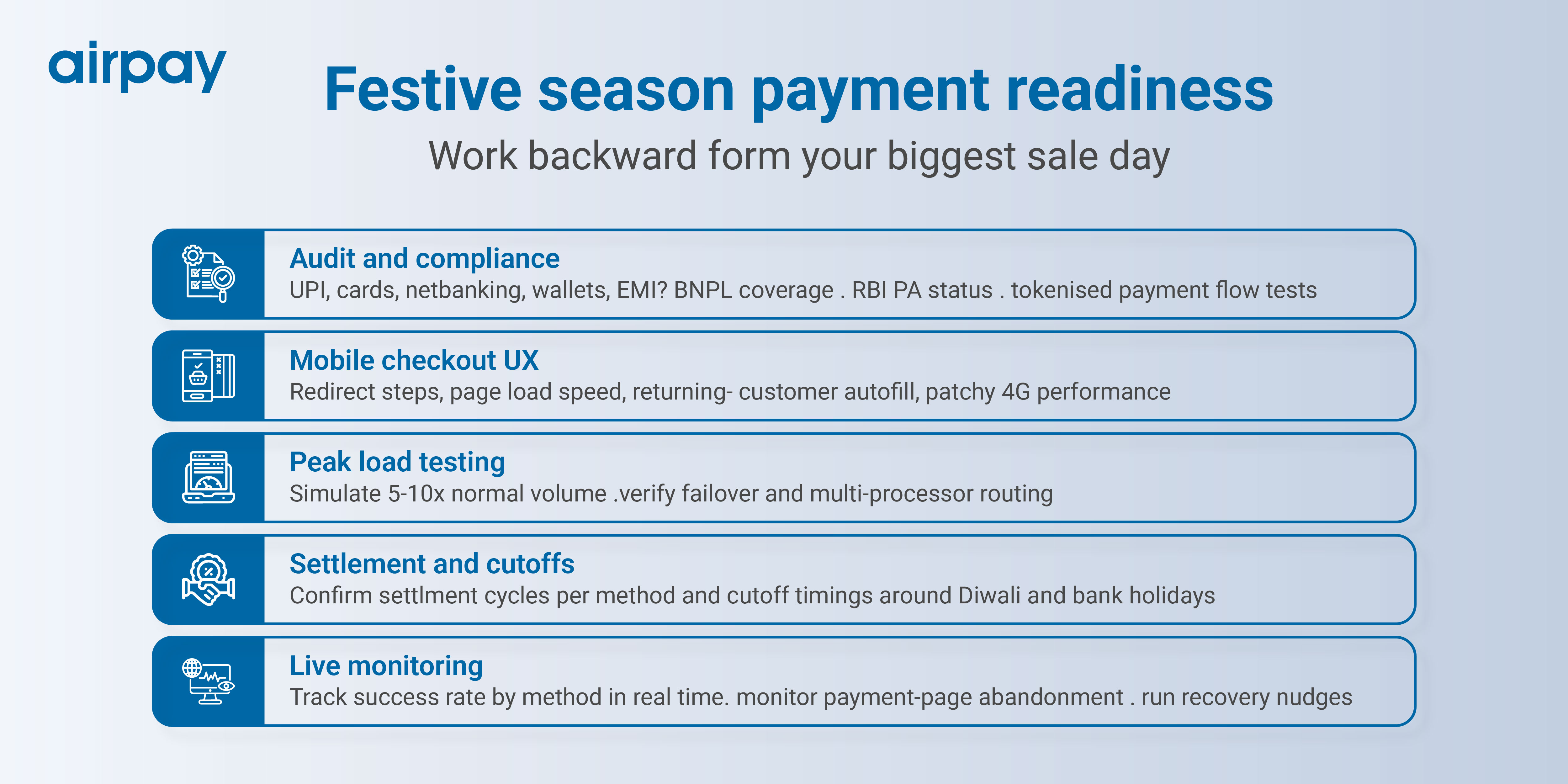
What actually breaks first
Forget the generic advice to test everything. Here's what tends to go wrong, in the order it tends to bite.
- Checkout under load. A flash sale doesn't ramp up gently. It's thousands of customers within a few minutes. This is where a high-traffic payment gateway either holds or buckles. Test your full payment flow at least 3 to 5 times the expected peak, not average daily volume, at least 2 to 4 times before your first sale. Confirm rate limits, timeouts, and recovery once the burst passes.
- Missing payment modes. Getting your payment methods for festive shoppers right matters more than almost any checkout feature. While UPI remains the default for most Indian shoppers today, others have their exclusive use cases. Cards and tokenised one-click flow bring repeat, high-volume customers. EMI payment options for festive-season purchases widen the funnel for big-ticket items a customer might otherwise defer. Miss one mode a segment relies on, and you don't lose a transaction. You lose the entire segment for the sale. We've broken down how limited payment options drive checkout abandonment elsewhere, and the pattern only gets sharper at festive volume.
- Friction at the last step. A customer at your payment gateway page is already close to buying. A fast, easy checkout with a genuine one-click flow is often the single biggest lever here. A slow load, one redirect too many, or a cart that clears when a customer switches payment modes is enough to lose the sale at the most expensive point in the funnel. With most festive traffic arriving on mobile, mobile checkout optimisation matters more during festive weeks than any other.
- Address and risk gaps. Most RTOs trace back to checkout, not delivery: an address the courier can't locate, an impulse COD order placed during a flash sale and later refused at the door, or no early signals that an order looks risky before it ships.
- Settlement and timing. Ad spend, vendor payments, and logistics costs go out on a fixed calendar. Festive receivables arrive on your payment provider's schedule, which doesn't move because your bills are due. Map the two, including which flows offer instant settlements, before the season, not after you notice the gap.
Fast, one-click checkout: where merchants lose sales without noticing
Every extra step at checkout costs orders during high-intent, time-pressured festive traffic. UPI Intent flows, saved and tokenised cards, and pre-filled address details for returning customers all cut the distance between add-to-cart and order confirmed.
A checkout that pushes customers through a separate redirect page, or asks for the same details twice, quietly loses conversions that no discount can win back. This is where a fast, near one-click checkout like airpay’s online dash checkout earns its keep: fewer fields, fewer redirects, and a flow built for a phone screen rather than adapted from a desktop one.
RTO gets filed under logistics, but a meaningful share of it is a payment and checkout problem. Three things help, and all three sit upstream of the courier:
- Address verification at checkout. Pin code-to-locality autofill, geolocation capture, and validation catch a bad address before the order is placed.
- Prepaid nudges. A small prepaid discount or a token COD fee shifts festive impulsive buyers toward prepaid, which carries a substantially lower RTO rate.
- Risk flags before dispatch. Repeat COD orders, address mismatches, and historically high-RTO pin codes are visible in your order data if you’re looking— flagging them is cheaper than processing the return.
Payment methods merchants should offer this festive season
| Method | Why it matters |
|---|---|
| UPI | Near-zero cost and the default choice for tier-2/3 and mobile-first buyers during festive impulse purchases. |
| Tokenised cards | Preferred by repeat, higher-value metro buyers who want a fast, saved-card checkout. |
| EMI and cashless EMI | Improves the affordability of high-ticket items: merchants have reported checkout success rates rising to 25 to 30% on big-ticket carts once EMI is offered. |
| Netbanking and wallets | Still relevant for segments underserved by UPI and cards, particularly first-time online shoppers. |
| Cash on delivery (with guardrails) | Necessary for some segments, but festive impulse buying spikes COD volumes, and COD returns run well above prepaid. Flag high-risk COD orders before dispatch using address and order-history signals. |
Missing even one of these methods loses an entire buyer segment, not just a few transactions.
High-traffic readiness: handling peak loads without losing transactions
- Run an actual load test, not a guess, at several times your normal transaction rate before the sale window opens.
- Set up smart routing across more than one payment processor so a single point of failure does not take down checkout during the ten highest-traffic minutes of the sale.
- Calibrate fraud rules ahead of time. Rules tuned for a normal week will misfire against genuine festive spikes and block real customers.
- Watch payment success rate by method in real time during the sale, not just at day's end. A dip in one method is fixable mid-sale if it is caught early.
Instant settlements: why cash flow breaks during the Diwali weekend
When your festive sale days land on a weekend, standard settlement cycles that pause on Saturdays and Sundays can lock up several days of revenue right when merchants need cash for ad spend, restocking, and vendor payments.
Standard settlement windows are built for an average week, not for a five-day sale that can generate a third or more of a merchant's annual revenue. Instant settlement keeps working capital moving through the sale window instead of waiting on the next business day, which matters most exactly when weekend and holiday cutoffs would otherwise sit on that money.
Ecommerce integrations: is your platform actually festive-ready?
If the store runs on Shopify, WooCommerce, Magento, or a custom stack, check that the payment gateway's plugin or API integration is current, not just installed. An outdated plugin version is a common, invisible cause of checkout errors during traffic spikes.
Test webhooks for payment success, failure, and refund events well before the sale. A webhook that silently fails during peak traffic means paid orders that do not show up in the system.
Run end-to-end test transactions across every payment method planned for the sale, not just the ones used most, since festive traffic tests every method at once.
Choosing the best payment gateway for high-volume festive sales in India
| What to check | Why it matters |
|---|---|
| Payment success rate track record | Directly determines how many festive-window customers actually complete their purchase. |
| Settlement speed and flexibility | Decide whether cash is available when it is needed most, including weekends and holidays. |
| RBI payment aggregator licensing | A gateway operating under valid RBI PA authorisation is a baseline requirement for compliance and merchant trust, not an extra. |
| Payment method breadth | Coverage across UPI, cards, EMI, net banking, and wallets within one integration. |
| Support during peak windows | A dedicated point of contact matters more during a live sale than at any other time of the year. |
How airpay gets you festive-ready
Reading the checklist is the easy part. The real work of online sale preparation for merchants is running every item on it, every season, and most teams don't have the bandwidth for it on top of everything else festive season demands. airpay's infrastructure takes that load off your team:
- No-code ecommerce integrations across 35+ platforms, including Shopify, WooCommerce, Magento, and Wix.
- Dash Checkout, a fast, easy, one-click checkout built to cut abandoned carts during high-traffic sale windows.
- Every payment mode your festive shopper expects — card, wallet, UPI, EMI payment options, and Pay Later — in one integration.
- Smart address autofill and RTO-focused checkout data, so fewer orders fail before they reach a courier.
- Built-in fraud protection aligned to global security standards, so risk rules don't start from a blank page.
- Click2Ship, moving a paid order straight to dispatch without a manual handoff.
- One dashboard for every order, refund, and settlement.
If fragmented online and offline channels are already quietly costing you sales, the festive season will only make that gap louder. We've covered why that fragmentation happens and how a unified stack closes it.
If you're running recurring collections alongside festive sales, EMIs, subscriptions, memberships, it's worth checking those rails too. We've covered how RBI's e-mandate rules are affecting recurring payment failures and what to do about it.
airpay operates as full-stack payment infrastructure with RBI PA-O, PA-P and PA-CB licensing across India, UAE and Tanzania, built for merchants who need every one of the checks above to hold up on the busiest days of the year, not just on paper. Festive season will reward the merchants who treated their payment gateway as infrastructure, not an afterthought. Run this checklist before the first sale day, not after the first drop-in success rate. Sign up with airpay to see if your payment gateway is ready for the festive rush.