You shipped the goods. The buyer confirmed receipt. The invoice went out weeks ago. Your account still shows nothing.
If you export, you’ve almost certainly been here. The waiting is frustrating; not knowing the reason is worse. The money might be sitting at your bank, at the buyer's bank, or in a compliance check somewhere in between that nobody mentioned.
The reassuring part: stuck export payments usually trace back to one of a handful of causes. Learn to recognise them, and most stop recurring.
They are common enough to be worth knowing cold. International buyers often take 60 to 90 days to settle, and for some MSME exporters it runs longer. With Indian MSMEs making up close to 48.55% of the country's merchandise exports in FY25, a payment stuck in limbo is a working capital problem for a sizeable share of exporters at any given time.
Here are the seven reasons payments get stuck, with a practical fix for each.
THE SHORT VERSION
- Most stuck payments come down to bad beneficiary details, mismatched documents, correspondent-bank delays, or a wrong purpose code.
- Around 90% of cross-border payments reach the destination bank within an hour, but only 43% reach the customer’s account that fast. The hold-up is inside the receiving bank, not on the wire.
- Almost every cause here is preventable — with a standard instruction sheet, a document checklist, and live tracking.
- Fix the process once and the same delays stop repeating.
Table of Contents
- Reason 1: Incorrect or incomplete beneficiary details
- Reason 2: Missing or mismatched documentation (FIRC, e-BRC, invoice)
- Reason 3: Correspondent bank delays in the SWIFT chain
- Reason 4: Wrong or missing purpose code
- Reason 5: AD Code or bank compliance holds
- Reason 6: Currency conversion and routing issues
- Reason 7: Manual, legacy payment processes with no tracking
- How your payment terms decide when you get paid
- A checklist for choosing an export payment partner
- Why exporters choose airpay
- Frequently asked questions
Reason 1: Incorrect or incomplete beneficiary details
This is the most common reason an export payment stalls, and the easiest one to prevent.
It usually begins with a small data error on the buyer's side: a wrong account number, an outdated IFSC or SWIFT code, or a beneficiary name that does not quite match your records. The payment leaves their account fine; it has nowhere to land on yours.
One wrong character in a SWIFT code is enough to park your payment in a queue with no release date.
What it looks like. The beneficiary's name does not match the account exactly (middle names, abbreviations, trading names); the SWIFT or BIC code is out of date after a merger or branch change; the account number was mistyped during manual entry.
How to fix it. Give every buyer a standard payment instruction sheet rather than letting anyone type details from memory. Recheck SWIFT and IFSC codes yearly and after any bank restructuring. Use a platform that validates beneficiary details before the transfer goes out, not after it bounces.
That one-page sheet takes minutes to send and removes the delay that catches more exporters than any other.
Reason 2: Missing or mismatched documentation (FIRC, e-BRC, Invoice)
An export payment is more than a bank-to-bank transfer. The paperwork proves the deal is genuine, and when it does not line up, the payment waits.
Through traditional channels, export payments usually settle in 2 to 5 business days, compared to 1 to 3 through optimised routing. A documentation problem stacks on to that fast.
Where paperwork tends to break. The invoice amount does not match the shipping bill or purchase order; a delayed FIRC holds up e-BRC filing; a pending e-BRC blocks LUT renewals and GST refunds; the HS code reads differently across documents.
A note on letter of credit discrepancies. If you get paid through a letter of credit, the bar is higher. The bank checks your documents against the exact wording of the LC, and any gap, however minor, counts as a discrepancy — at which point it issues a discrepancy notice rather than releasing your money. The usual culprits: an invoice exceeding the LC value, a goods description that does not match word for word, documents presented after expiry, or a quantity that differs across two documents. LCs are judged on strict compliance, so the only real defence is to check every document against the LC terms yourself before presenting them.
How to fix it. Match invoice, purchase order, and shipping bill values before raising the request. Ask your bank early how long FIRC will take. Keep a document checklist for every shipment.
Reason 3: Correspondent bank delays in the SWIFT chain
Many exporters assume the money travels straight from the buyer's bank to theirs. In practice, it passes through one or more correspondent banks first, and each step adds delay.
The SWIFT data makes the point. Around 90% of cross-border payments reach the destination bank within an hour, but only 43% are credited to the customer's account within that same hour. Most of the hold-up is the receiving bank's own processing: regulatory checks, batch cycles, and local operating hours.
What slows it down. Banks in different time zones with little overlap; a correspondent holding the transaction for review; several banks charging fees, making the final credited amount hard to predict.
How to fix it. Ask your bank for the MT103 reference, the unique ID that traces a wire end to end. Prefer partners that keep correspondent hops to a minimum, and one that gives live tracking rather than a helpline.
Related: Why Traditional Bank Transfers Cost Your Export Business More — and What to Do Instead
Reason 4: Wrong or Missing Purpose Code
Every inward remittance into India needs an RBI purpose code stating what the payment is for. If it is wrong or missing, the bank holds the payment and comes back to you for an explanation.
Why it happens. The buyer’s bank selects a generic or wrong code; your bank wants manual confirmation before crediting; or the code does not match the goods you declared elsewhere.
How to fix it. Share the correct purpose code with your buyer’s bank in advance, confirm which code applies to your export category, and respond fast when a payment is held — the delay continues until you do.
Also read: RBI's E-Mandate Rules and Recurring Payment Failures
A purpose code is easy to overlook, but a bank's compliance system treats it as the deciding factor in whether a payment clears.
Reason 5: AD Code or bank compliance holds
Your Authorised Dealer (AD) Code links your export transactions to a specific bank branch for regulatory reporting. Payments get held when it is not registered with the shipping port on ICEGATE, when KYC is out of date, when a transaction value crosses a review threshold, or when the buyer corridor draws extra scrutiny — even if everything else is in order.
How to fix it. Confirm your AD Code is active at every port you ship from, keep KYC and export documents current, and check what extra compliance applies before entering a new market.
Reason 6: Currency conversion and routing issues
Sometimes a payment is not stuck so much as taking a longer route home. When funds convert through a third currency before reaching INR, settlement gets slower and less predictable.
It usually means two conversions instead of one — the buyer’s currency to USD, then USD to INR — at a rate set by an intermediary bank you never see, with no fixed timeline for when it happens. It also costs more: many gateways add a currency markup over the spot rate that is not shown in advance.
How to fix it. Agree a direct settlement currency where you can, ask for the rate at initiation rather than only at settlement, and use a platform that shows the credited amount before you commit.
Reason 7: Manual, legacy payment processes with no tracking
For many exporters, the process itself is the problem. Plenty of SMEs still run payments through emails, calls, and spreadsheets, so when something goes wrong, there is no single place to see where it stopped.
Signs your process is the issue. You learn of a delay by calling your bank rather than being told; there is no record of where past payments got held up; reconciliation is a month-end scramble; different people track different parts of the same payment.
How to fix it. Use a platform that shows live status from initiation to credit, automates reconciliation against your invoices and shipping documents, and keeps documentation in one dashboard instead of email threads.
How your payment terms decide when you get paid
Long before any document is filed, the terms you agree with your buyer decide how much risk you carry and how long you wait. Advance payment is kindest to cash flow but hardest to negotiate. A letter of credit gives strong cover but is document heavy. Documentary collection swaps documents against payment with no bank guarantee. Open account — ship now, paid in 60 to 90 days — is easiest for the buyer and riskiest for you.
No single term wins every time. It turns on how well you know the buyer, the order size, and how settled the market is: a new buyer or untested corridor usually calls for an LC or advance; a long-standing buyer can move to open account. Matching the term to the deal keeps working capital predictable.
A checklist for choosing an export payment partner
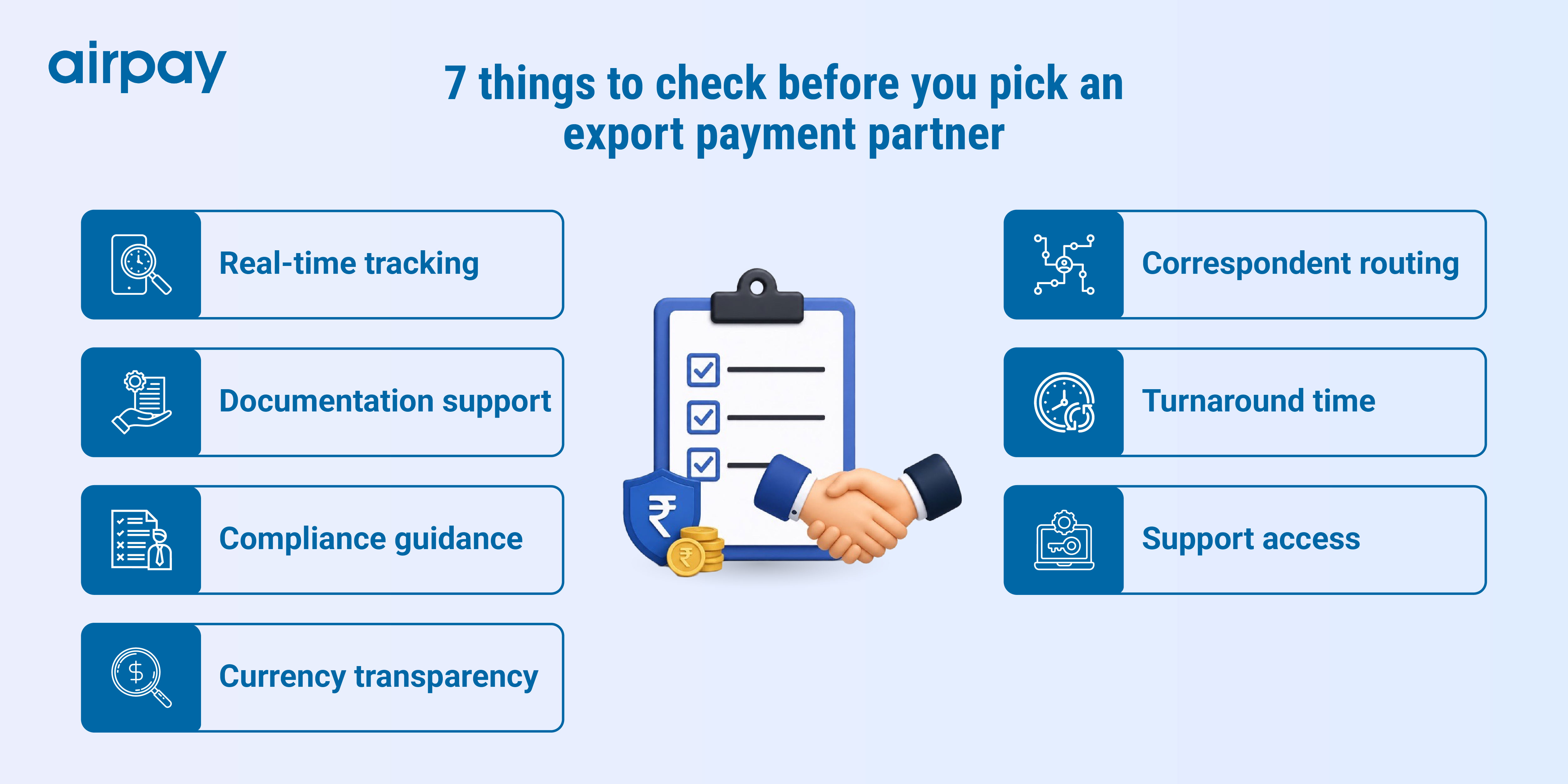
| Real-time tracking | More than just ‘sent’ and ‘received’ |
| Documentation support | FIRC and e-BRC generated automatically |
| Compliance guidance | AD Code, purpose code, and KYC flagged up front |
| Currency transparency | Conversion rates shown before settlement |
| Correspondent routing | How many banks the payment passes through |
| Turnaround time | Average days to credit, not the best case |
| Support access | A named contact, not a generic helpline |
Why Exporters Choose airpay
airpay has operated where Indian trade meets digital payments since 2012. Its export setup is built around the compliance realities exporters face daily: purpose code accuracy, AD Code alignment, FIRC and e-BRC turnaround, and a clear view of where a payment sits at any moment.
- End-to-end payment tracking on a single dashboard.
- FIRC and e-BRC generated automatically.
- Purpose codes and compliance requirements set out in advance.
- Transparent conversion, with the credited amount shown beforehand.
- A dedicated team to clear payment holds when they come up.
Would rather stop chasing payments that are already yours?
See how airpay gets export payments in faster — tracking, documentation, and compliance handled inside the flow.
Frequently Asked Questions
Q: How long should an export payment normally take to credit?
A: A typical international wire transfer should credit within 2–5 business days of initiation. You need to investigate and follow up in case it gets delayed beyond this.
Q: What is an e-BRC, and why does it matter if my payment is delayed?
A: An e-BRC confirms an export payment has been received against a specific shipment. It’s required for GST refunds and LUT renewals, so a delayed payment also delays those benefits.
Q: Can a wrong purpose code really hold up my entire payment?
A: Yes. RBI uses purpose codes to classify foreign remittances. An incorrect or missing code can trigger a manual review that pauses the credit until clarified.
Q: Do I need a separate AD Code for every port I export from?
A: Your AD Code must be registered with each port (via ICEGATE) you ship through. If it’s only registered with one and you ship from another, your shipping bill may not clear correctly.
Q: Is it normal for the credited amount to be less than the invoice value?
A: Some difference is expected from conversion and bank charges. If the gap is large or unpredictable, ask for a breakdown and consider a provider that shows this upfront.