A garment exporter in Gurgaon ships a container to a buyer in New York for an invoice value of $42,000. The buyer pays the money Monday morning, US time. Payroll is due Friday.
Tuesday: nothing. Wednesday: nothing. Thursday, 11 am: ₹40.5 lakh lands.
Four days. No explanation. No alert. Just a number that eventually shows up.
Here is what nobody tells that exporter: the money was not moving for four days. It reached his bank in India within minutes of being sent. It then sat in queues, in batches, and behind cut-off times.
SWIFT’s own data shows that 75% of cross-border payments reach the beneficiary bank within ten minutes. Industry research puts roughly 80% of total cross-border transaction time in the “last mile” — the stretch after the message has already arrived.
Four-fifths of your wait happens after the money reaches your bank. The delay is not distance. It is process, and process, unlike geography, can be worked around.
The short version
- Your payment reaches the receiving bank in minutes, not days. 75% arrive within ten minutes.
- A direct SWIFT transfer with no currency conversion typically lands in 24–48 hours. A cross-currency transfer averages roughly 4.6 days.
- Nearly every Indian export receipt is cross-currency — so 4.6 days is your baseline, not your bad day.
- The wait comes from four fixable causes: missed cut-offs, correspondent hops, FX sourcing, and batch runs. Three are partly within your control.
Table of Contents
- How Long an International Payment Actually Takes
- Where the Five Days Actually Go: The 5 Stages of a SWIFT Delay
- Why Cross-Currency Payments are the Slowest of All: 4.6 days vs 48 hours
- What a Five-Day Delay Actually Costs your Business
- How to Speed Up Export Payment Settlement: 6 Practical Fixes
- How airpay's Cross-Border Collections Cut Settlement Time
- Frequently asked questions
How Long an International Payment Actually Takes?
Ask most people why an international wire is slow, and they will say that the money has a long way to go. Intuitive. Also wrong.
Money does not physically travel. What moves is a message- an instruction telling one bank to debit an account and another to credit one. SWIFT carries that message, not the cash.
One study of 5,621 real SWIFT transactions found an overall average processing time of about 27 hours, with 64% arriving inside 24 hours. So, the headline number is not catastrophic. The problem is the spread — and what pushes a payment to the wrong end of it.
Domestic transfers usually clear within a day. International ones can take five. The gap has almost nothing to do with the distance, and everything to do with how many institutions touch the instruction along the way, and what each one does with it before passing it on.
So, the real question was never Where is my money? It is which desk is it sitting on, and what is it waiting for?
Where the Five Days Actually Go: The 5 Stages of a SWIFT Delay
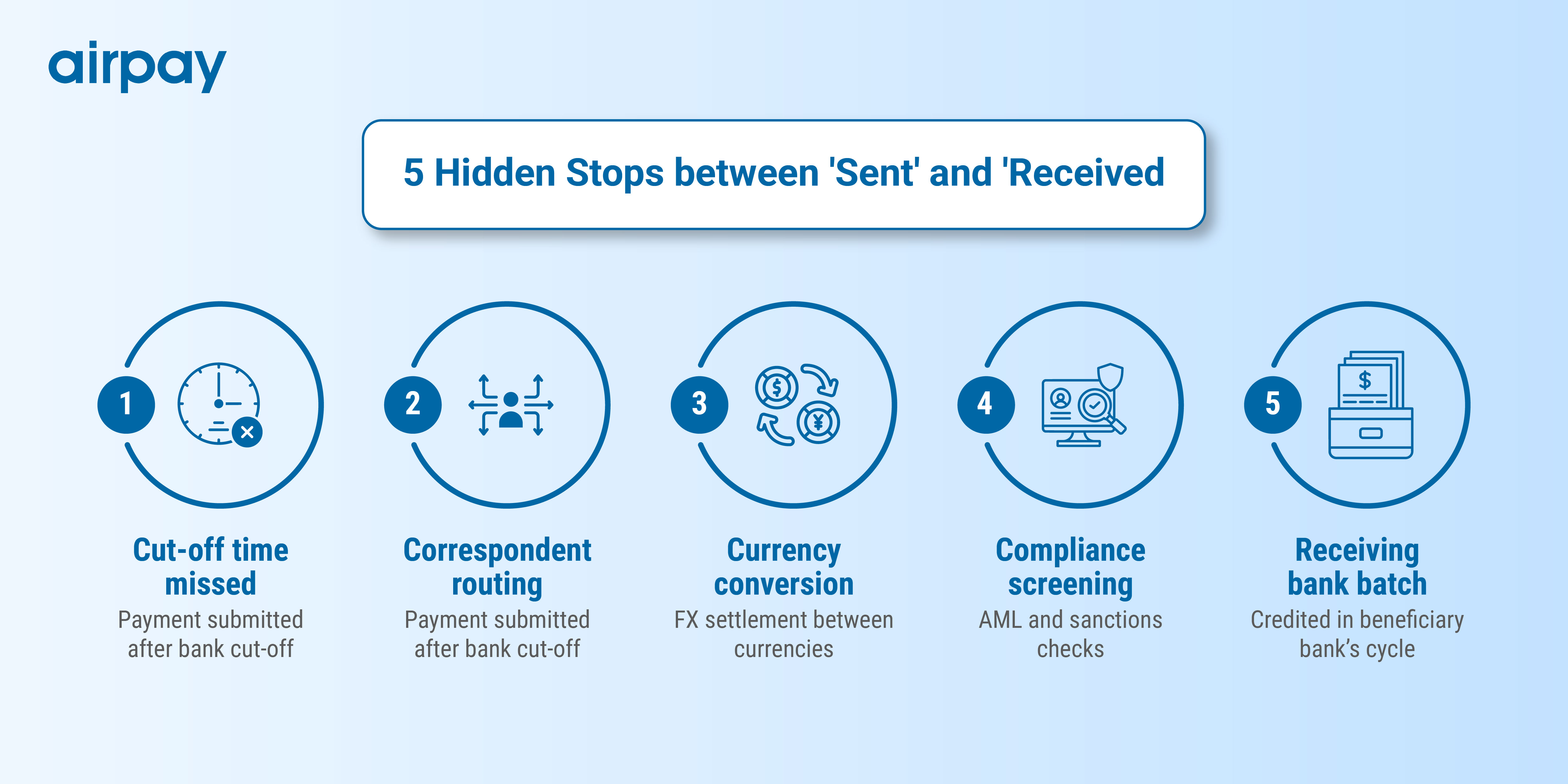
| Stage | What happens | Typical time lost |
|---|---|---|
| Missed cut-off | Payment arrives after the day’s processing window closes | Up to 1 business day |
| Correspondent hops | Each intermediary bank runs its own checks, in its own time zone | 1–2 days |
| Currency conversion | Receiving bank sources the currency before crediting | 1–3 days |
| Compliance screening | AML and sanctions checks at sender, receiver and every correspondent | Hours to 1 day |
| Receiving bank batch | Internal verification and batch processing after funds have “arrived” | 1–2 days |
Missed cut-off times: why a SWIFT payment can wait a full business day
Every bank runs on a daily deadline. Miss it, and payment stops being today’s problem —it becomes tomorrow’s.
Cut-off times typically fall between 2 pm and 5 pm local time, and international wires are usually cut off earlier than domestic ones, partly to leave room for manual compliance review before the day closes.
Miss it by five minutes, and the payment waits a full working day before anything moves. Miss it on a Friday afternoon, and you have bought yourself the weekend.
This hits Indian exporters the hardest. Funds arriving after 4 pm IST typically wait until the next morning for INR credit — an automatic extra business day. Add second and fourth Saturdays as bank holidays, and a Friday-afternoon payment can sit far longer than anyone budgeted for.
Nobody sends you an alert about this. The payment simply does not move.
Correspondent banks: the hidden hops that add a day or more
Your bank and your buyer’s bank almost certainly do not have a direct relationship. Most banks do not. So, the payment routes through one or more correspondent banks — institutions that hold accounts for each other and settle on one another’s behalf.
Each correspondent processes the payment independently. Each runs its own compliance checks, may apply its own exchange rate, and works to its own business hours and cut-off schedule. Every hop is a fresh queue, in a fresh time zone.
The transaction data makes the cost of this plain. In that same 5,621-payment study, 75% of transfers passed through at least one intermediary, averaging 1.31 intermediaries per payment. Transfers that used intermediaries averaged 1 day 11 hours. Transfers that bypassed them averaged 15 hours.
You have almost no visibility into any of this. Unless you ask. And you are allowed to ask. Request the MT103 — the document confirming your payment was sent, showing the exact route it took. Or ask for the UETR, the unique end-to-end reference that lets your bank pinpoint precisely where in the SWIFT chain your money is sitting.
You are entitled to both. Most exporters never request either.
Currency conversion delays: why FX processing adds 1–3 days
If your buyer sends dollars and you are expecting rupees, someone has to convert the money, and that someone needs to actually have the currency on hand.
If the receiving bank does not hold the sending currency readily, it sources it from another institution. That is exactly as slow as it sounds, and slower still for less commonly traded currency pairs. The transaction stops being a simple payment and becomes a payment, an FX trade, and a multi-currency settlement stacked on top of each other.
AML and sanctions screening: why compliance checks slow settlement
Every international transfer is screened for anti-money-laundering and sanctions risk at the sending bank, screened again at the receiving bank, and potentially screened at every correspondent in between.
Most clear automatically. Some get pulled aside for a human to review — and humans keep office hours.
This friction exists for a reason, and it isn't incompetence: once a transfer completes, there's very little chance of recovering funds that turn out to be fraudulent. Wire transfers are deliberately slowed at multiple stages, and the delay is, in part, the system working as designed.
Cold comfort when it is your working capital sitting idle.
Receiving bank processing: why funds sit even after they have landed
This is the big one — and the one nobody warns you about.
Remember that ten-minute figure? The 80% of transit time spent in the “last mile”? Those remaining days are spent entirely inside the recipient bank's own systems: batch processing, internal verification, local operating hours, its own cut-offs. Some banks hold incoming wires briefly for additional verification, so funds don't appear immediately even after they've arrived.
Your money is not lost somewhere over the Arabian Sea. It is in a queue in a back office, waiting for the next batch run.
Related reading: Why Your Export Payment Is Stuck: 7 Common Reasons and How to Fix Them
Why Cross-Currency Payments Are the Slowest of All: 4.6 days vs 48 hours
If you want one number that explains your five-day wait, this is it.
A direct SWIFT transfer with no currency conversion typically arrives within 24 to 48 hours. A cross-currency SWIFT transfer averages roughly 4.6 days — about 111 hours.
Same network. Same technology. The only difference is one extra step — converting currency — and that single step roughly doubles or triples the wait.
For an Indian exporter invoicing in dollars, euros, or pounds, this is not an edge case. It is every payment you handle. Nearly all export receipts are cross-currency transfers, which means 4.6 days is not the unlucky exception. It is the baseline you should be planning cash flow around.
What a five-day settlement delay actually costs your business
Five days does not sound like much until you put a number next to it.
Take that same $42,000 invoice — roughly ₹40.5 lakh at current rates. At a conservative 9% annual cost of working capital, four extra days of blocked funds costs about ₹4,000 — not in fees, but in lost use of money that was already yours.
One shipment, ₹4,000. Four shipments a month, ₹16,000. Across a year, close to ₹2 lakh evaporating into other people’s processing queues. It never appears on an invoice, never gets questioned in a review, and never stops.
And the cash cost is only half of it. The other half is deciding blind — payroll planned around guesswork, supplier payments delayed because inbound funds have not cleared, credit lines drawn simply to bridge a gap that should not exist.
The five-day wait does not just cost money. It costs certainty.
How to Speed Up Export Payment Settlement: 6 Practical Fixes
You cannot rebuild correspondent banking. You can stop losing days to avoidable delays.
- Send early in the week, and early in the day. Initiating before the cut-off prevents a weekend delay — the cheapest fix available to you. Ask your bank for its specific international wire cut-off; it is usually earlier than the domestic one.
- Get the paperwork right before you initiate, not after. Purpose codes, invoices and FIRC requirements should be locked in before the transfer goes out. A wrong purpose code does not just slow a payment — it stops it and restarts your clock from zero.
- Standardise your beneficiary details. Consistent recipient information avoids name-matching delays. Accurate BIC/SWIFT codes with complete beneficiary details prevent automatic rejection and reprocessing. One mismatched initial can cost you two days.
- Build a buffer and stop apologising for it. Add two to three business days to any critical payment deadline to absorb compliance delays — more if conversion or intermediaries are involved. If money must land by a specific date, plan for five business days.
- Trace it, do not wait for it. Ask for the MT103 or UETR on day two, not day five. The UETR lets your bank pinpoint exactly where your payment sits in the chain. Note that the full hop-by-hop view is visible only to member banks, so you will need your bank to look on your behalf.
- Ask about the corridor before you sell into it. Find out whether your recipient corridor typically routes through correspondent banks. If it does, you are planning around a completely different timeline.
Related reading: Why Traditional Bank Transfers Cost Your Export Business More, and What to Do Instead
How airpay’s Cross-Border Collections Cut Settlement Time
The structural insight is simple. Every correspondent bank you remove is a queue you skip.
That is the principle behind how modern payment platforms beat the five-day wait. Local payment rails and internal settlement remove the handoff points that SWIFT and correspondent chains introduce. Direct corridors cut the intermediary chain from three or four stops to one or two, and with each stop goes the dead time between processing windows.
airpay has worked at the meeting point of Indian trade and digital payments since 2012. It's one of the few payment aggregators in India holding all three RBI Payment Aggregator licences — PA-O, PA-P, and PA-CB — and its export collections are built around the realities above.
- Fewer hops, faster credit. Direct settlement rails cut out the correspondent chain that quietly adds a day or more to every transfer.
- Conversion you can see before you commit. The credited INR amount is shown upfront — no waiting until Thursday to learn what Monday’s dollars became.
- A live status, not a hold line. Track exactly where a payment sits, instead of calling a helpline that tells you to wait one more day.
- FIRC handled inside the flow. Documentation for compliance and taxation is generated as part of the collection, not chased down afterwards.
- A named team for exceptions. When a payment is held for review, there is someone accountable for resolving it — not a queue.
The point is not that payments become magic. It is that you stop losing days, and money, to queues you never knew existed.
Still chasing a payment that already reached your bank?
airpay’s cross-border collections give exporters real-time visibility and faster settlement, so you know where your money is instead of guessing.
See how airpay handles export payments →
Frequently Asked Questions
Q: How long should an export payment take to settle?
One to five business days is the standard range, but the honest answer depends on conversion. A direct SWIFT transfer with no currency conversion typically arrives within 24 to 48 hours, while cross-currency transfers average around 4.6 days. Most Indian export receipts fall into the second category.
Q: Why does my bank say the payment was sent when the money is not here?
Because both statements are true. The instruction has left. Most payments reach the beneficiary bank within minutes, and the days are spent inside the receiving bank’s own processing. Ask for the MT103 to confirm it was sent, then ask the recipient bank to check its incoming queue.
Q: What is an MT103, and how do I get one?
It is the document confirming a payment was sent, showing the route it took. Request it from your bank. You can also ask for the UETR, the unique end-to-end transaction reference, which lets your bank trace exactly where the payment sits in the SWIFT chain.
Q: Can an export payment take longer than five days?
Yes. Extended fraud checks, corrections to incorrect details, currency conversion, or transfers initiated outside operating hours can push a transfer to a week or longer. Some slow corridors take considerably more, and your bank will usually know which ones they are.
Q: Does the amount I receive change along the way?
It can. Intermediary banks may deduct fees from the transfer amount before it reaches you, and the foreign exchange spread typically adds one to three percent over the mid-market rate. This is why the credited figure often does not match the invoice.
Q: Is there any way to get same-day international settlement?
Through a traditional bank, rarely. Same-day delivery is uncommon and usually offered only as an expensive premium service. Where it exists, it generally requires early initiation and no currency conversion.