Selling across borders is the part that’s easy to get excited about. Getting paid safely, on time, and in a currency that actually reaches your account is the part that quietly decides whether the whole thing works.
When money moves between countries, it passes through more hands, more systems, and more compliance checks than a domestic sale ever does. Each touchpoint is a place where a payment can be delayed, skimmed by fees, or exposed to fraud. Your gateway sits in the middle of all of it.
And the fraud risk isn’t hypothetical. Industry fraud reports consistently show cross-border card transactions running at meaningfully higher fraud rates than domestic ones, often cited at two to three times higher. So choosing the right gateway is less a technical footnote than a decision that shapes your cash flow and your risk.
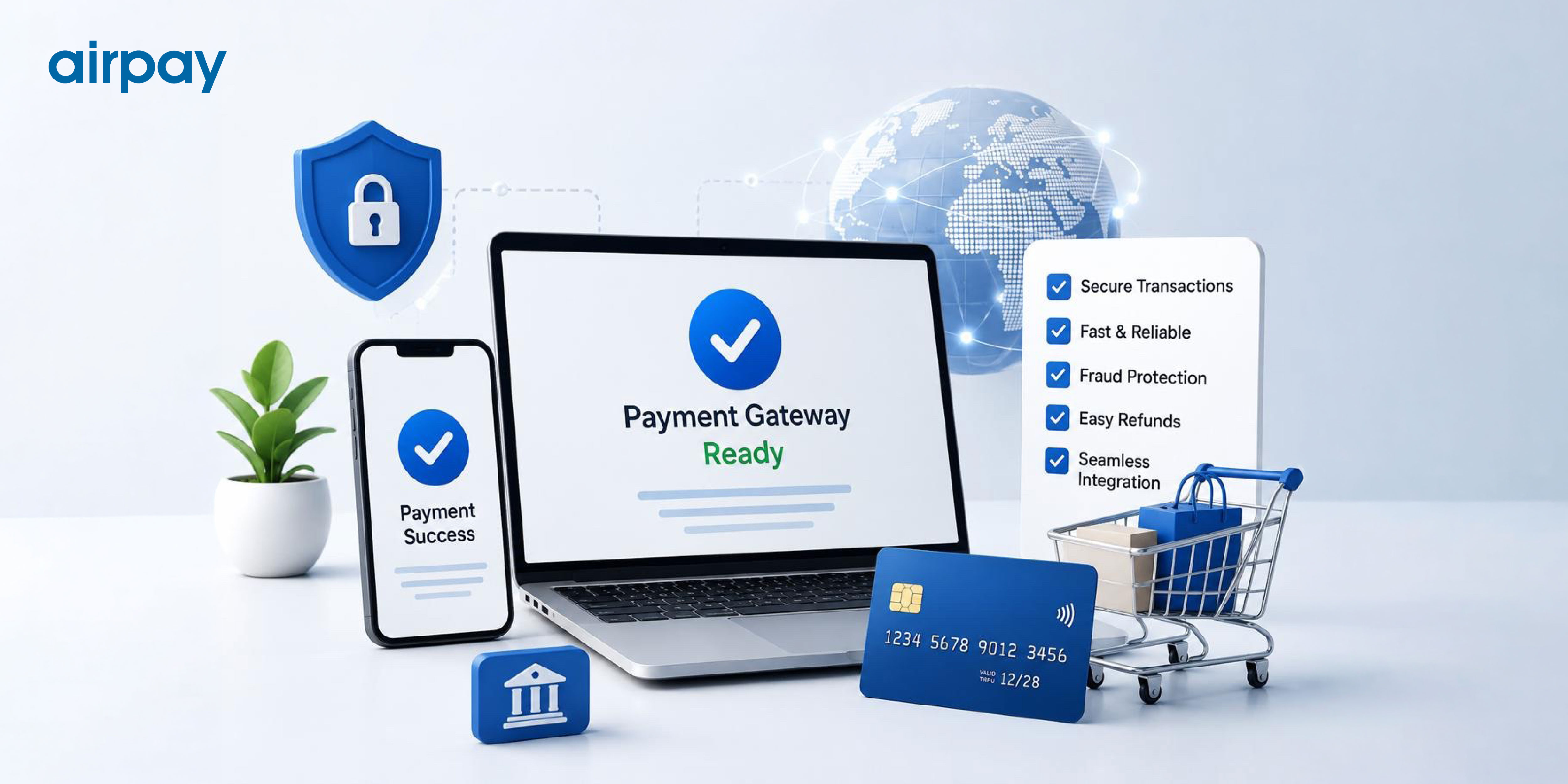
This is a straight, practical checklist for choosing a secure payment gateway built for international trade.
The Short Version
- Start with PCI DSS. A Level 1 certified gateway moves most of the compliance weight off your business and onto the provider.
- Encryption and tokenisation do different jobs, and a secure gateway uses both, so raw card numbers never sit on your systems.
- Cross-border fraud runs well above domestic rates, so real-time screening and 3D Secure 2 earn their keep.
Then check multi-currency settlement, transparent FX, and clear support. The full checklist is below.
Table of Contents
- Why Gateway Security Matters More in International Trade
- PCI DSS Compliance: The Non-Negotiable
- Encryption and Tokenisation
- Fraud Prevention and Transaction Limits
- Multi-Currency Support and Transparent Settlement
- Recurring Billing and Invoicing
- The Quick Checklist
- Why Exporters Choose airpay
- Frequently Asked Questions
Why Gateway Security Matters More in International Trade
A domestic sale usually travels a short, familiar path. A cross-border one doesn’t. It can pass through the buyer's bank, one or two correspondent banks, a currency conversion, and a compliance review before it ever reaches you, and at every step the fraud exposure is higher than a local sale carries.
That longer path is exactly why the gateway matters. It is the layer that protects card data, screens for fraud, and keeps you on the right side of the rules that govern global trade. Get it right, and payments become boring, which in payments is the highest compliment there is. Get it wrong, and you inherit chargebacks, data-breach exposure, and the kind of compliance headache that follows you into every market you sell into.
Related reading: Why Your Export Payment Is Stuck: 7 Common Reasons and How to Fix Them
PCI DSS Compliance: The Non-Negotiable
Start here, because everything else sits on top of it. PCI DSS, the Payment Card Industry Data Security Standard, is the ruleset the card networks built to govern how card data is stored, processed, and transmitted. Any gateway worth considering will be compliant, and the best is certified at the highest level.
The practical value is simple: compliance moves off your shoulders and onto the provider’s. When the gateway handles card data inside its own certified environment, your business touches far less sensitive information, which shrinks both your audit scope and your risk if something goes wrong.
Look for:
- PCI DSS Level 1 certification, the tier meant for the highest transaction volumes
- Verifiable compliance, meaning a provider that appears on the card networks’ lists of compliant companies, not one that merely claims to be “PCI aware”.
- Clarity on scope, so you know which requirements the gateway covers for you and which stay with your business.
A quick test. Ask a prospective provider for their current PCI DSS attestation. A genuinely compliant gateway will have it ready and current. PCI DSS v4.0.1 has been the only active version since the end of 2024, with all of its requirements mandatory since March 2025. If a provider hesitates on this one document, everything else deserves a second look.
Encryption and Tokenisation
These two often get mentioned in the same breath, but they do different jobs, and a secure gateway uses both.
Encryption scrambles card and payment data into unreadable ciphertext, so even if it’s intercepted in transit, it means nothing without the key. Look for end-to-end encryption covering data in transit and at rest, over TLS 1.2 or higher. That’s the baseline that keeps card details private as they move across the internet and between banks.
Tokenisation goes a step further. Instead of storing or passing the real card number, the gateway swaps it for a token, a randomly generated stand-in that is worthless to anyone who steals it. The genuine card number stays locked inside the provider's certified vault and never lands on your servers. For recurring billing especially, this is what lets you charge a returning customer securely without ever holding their actual card data.
If a provider can explain exactly where the real card data lives, that's a good sign. If they can't, keep looking, because a “we're not sure” answer here really means “you're the one holding the risk.”
Fraud Prevention and Transaction Limits
Security isn’t only about protecting data at rest. It is also about catching bad transactions before they settle, not after they’ve already cost you the money. Cross-border payments attract more fraud attempts than domestic ones, so the screening layer earns its keep.
The non-negotiables here:
- Real-time fraud detection that scores transactions as they happen, not after.
- 3D Secure 2 authentication, which adds a verification step without adding friction for genuine buyers.
- Velocity checks and configuration rules you can tune to your own risk appetite and markets.
Transaction limits matter too. A good gateway lets you set a per-transaction limit and a daily or monthly cap- partly budgeting, partly protection. A sensible limit stops a compromised account from running up damage and keeps unusual payments from clearing without a second look, like a seatbelt you hope never to need.
Multi-currency support and transparent settlement
If you sell into multiple countries, a gateway that speaks only one currency will cost you, in conversion fees and in lost sales from buyers who cannot pay the way they want to.
Here's what to check for:
- True multi-currency acceptance that lets buyers pay in their own currency and settles cleanly to you.
- Transparent foreign exchange, with the rate shown at initiation and the amount you'll actually receive made clear before you commit.
- Local payment method support for what dominates your buyers' home markets, not just cards.
The transparency point matters more than it looks. Hidden conversion markups quietly erode cross-border payments. The money doesn't vanish; it just never arrives in the first place. A provider that shows its FX up front is protecting your margin, not just your data.
Related reading: Why Traditional Bank Transfers Cost Your Export Business More, and What to Do Instead
Recurring Billing and Invoicing
Not every exporter needs this. But if any part of your business runs on subscriptions, retainers, or repeat orders, it belongs on your checklist.
A gateway with native recurring billing handles repeat charges, recurring invoices, and expiring-card updates on its own, so you’re not manually re-billing every cycle. Look for a setup that manages the full subscription lifecycle, from first charge through renewals, retries, and cancellations, while keeping card data tokenised throughout.
Check for:
- Support for recurring billing and subscription payments in multiple currencies.
- Automatic retries and card-update handling, so a failed renewal doesn't quietly become lost revenue.
- A simple way to create and send invoices, and to track which are paid.
The Quick Checklist
When you’re comparing providers side by side, run each one against this before you commit:
What to check | What good looks like |
|---|---|
| PCI DSS compliance | The provider is a PCI DSS Level 1 certified company, not just 'PCI aware' |
| Encryption | End-to-end encryption in transit and at rest, TLS 1.2 or higher |
| Tokenisation | Card data replaced with a token, so raw numbers never sit on your systems |
| Multi-currency support | Accepts and settles in the currencies your buyers actually pay in |
| Fraud prevention | Real-time fraud detection, velocity checks, and 3D Secure 2 |
| Transaction limits | Per-transaction and daily limits that fit your ticket sizes |
| Recurring billing | Native support for subscriptions and recurring invoices if you need them |
| Settlement clarity | Clear timelines, transparent FX, and the credited amount shown up front |
| Support access | A named contact for disputes and holds, not a generic helpline |
Why Exporters Choose airpay
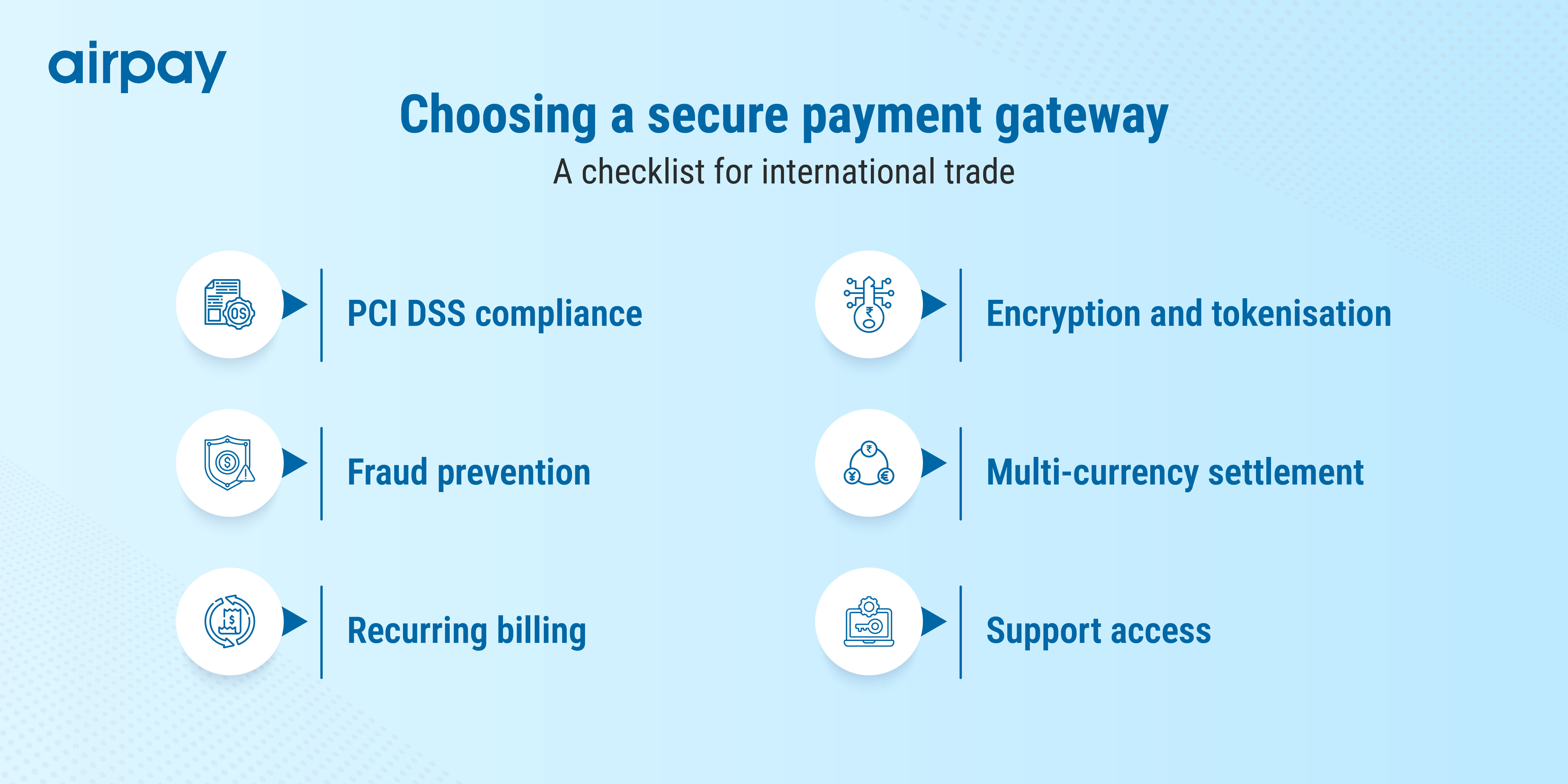
airpay has worked at the meeting point of Indian trade and digital payments since 2012, and its cross-border setup is built around exactly the checklist above: PCI DSS-compliant, RBI-authorised with encryption and tokenisation by default, real-time fraud screening, multi-currency acceptance, and transparent settlement wherein you see the credited amount in advance.
What that gives you:
- PCI DSS compliant handling, so card data stays inside a certified environment, not on yours.
- Encryption and tokenisation as standard, for cards and for recurring billing.
- Multi-currency acceptance with transparent foreign exchange.
- Fraud detection and configurable transaction limits tuned to your markets.
- A dedicated team to clear disputes and payment holds when they come up.
If security and clean settlement are what stand between you and confident international trade, it is worth seeing a purpose-built platform in action.
Ready to accept international payments securely? Talk to us about the payment setup built for global trade.
Frequently Asked Questions
Q: What makes a payment gateway secure for international trade?
Three things carry most of the weight: PCI DSS compliance, strong encryption, and tokenisation. Together they mean card data is protected in transit, never stored in raw form on your systems, and handled by a provider audited against the payment card industry's own standard. Multi-currency support and real-time fraud detection round it out for cross-border trade.
Q: What is PCI DSS, and why does it matter for a payment gateway?
PCI DSS is the Payment Card Industry Data Security Standard, the ruleset that governs how card data is handled. A PCI DSS-compliant payment gateway has been independently audited against it. Choosing a PCI-compliant gateway is the simplest way to shift most of that compliance burden off your own business.
Q: What is the difference between encryption and tokenisation?
Encryption scrambles card data so it cannot be read without a key. Tokenisation goes a step further and swaps the card number for a meaningless stand-in token, so the real number never touches your servers at all. Good gateways use both.
Q: Can I set transaction limits on an international payment gateway?
Yes. Most gateways let you configure a per-transaction limit and a daily or monthly cap. This matters for cross-border trade, where ticket sizes vary, and a sensible bank transaction limit is a useful fraud control as well as a budgeting one.
Q: Does the gateway support recurring billing for international customers?
If you run subscriptions or retainer-style invoices, check for native recurring billing. A gateway with recurring payment support handles repeat charges, recurring invoices, and card updates automatically, rather than you re-billing by hand each cycle.